Social & External
The people behind it
Lucía Méndez
Vanessa Hernández de Saint-Michel
Héctor Bonilla
Luciano Saint Michelle
Rogelio Guerra
Pierre Saint Michelle
Angélica Aragón
Luisa Servin
Nuria Bages
Jane
Isabela Corona
Cecile Saint Michelle
Alma Delfina
Lolita
El amor no es como lo pintan is a Mexican telenovela produced by Juan David Burns and Elisa Salinas for TV Azteca. It was broadcast on Azteca 13 from November 6, 2000 to April 27, 2001 for 165 episodes.
Laila is a Syrian victim of a bombing who agrees to marry a powerful sheikh in exchange for money to save her little brother's life. However, plans change due to the tragic death of the child. Laila and her family flee to start a new life in distant lands. Abandoned and enraged, the sheikh sends Jamil, his right-hand man, in search of the bride, but could not imagine he would fail to obey his command and fall madly in love with her. This forbidden love will be tested when the sheikh's daughter decides to take revenge after her father's mysterious death. From Emmy winners Thelma Guedes and Duca Rachid, ‘Orphans of a Nation’ tells a beautiful love story in the current context of refugees from around the world.
Guerra de mujeres is a telenovela produced by Venevisión in 2001. Gaby Espino and Jorge Reyes starred as the main protagonists.
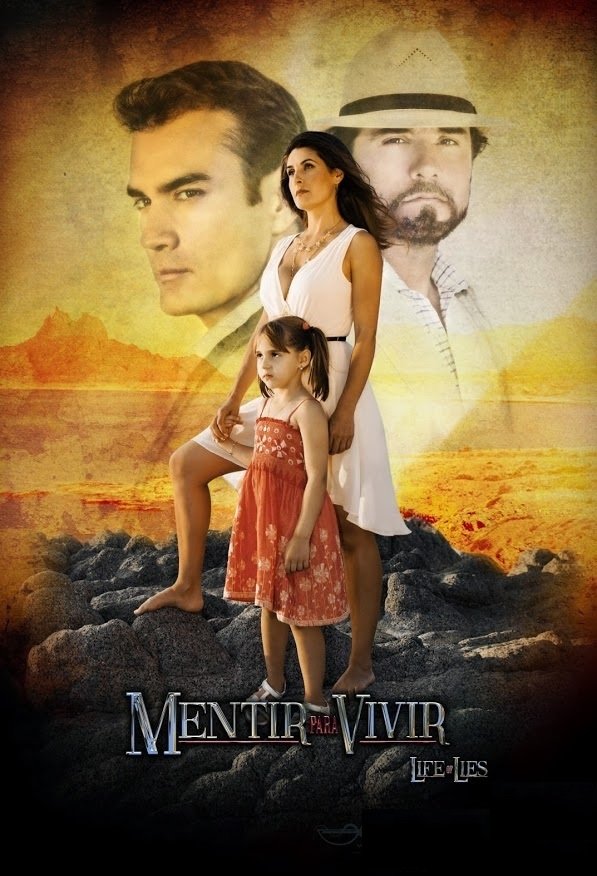
Mentir para vivir is a Mexican telenovela produced by Rosy Ocampo for Televisa. The telenovela is written by Maria Zarattini, who last wrote La Fuerza del Destino. Mayrín Villanueva and David Zepeda star as the protagonists, while Altair Jarabo, Leticia Perdigón and Diego Olivera star as the antagonists.
Corazón en Condominio is a Mexican telenovela produced by Azteca in 2013. It stars Victor García and Cynthia Rodríguez as the main protagonists. It is based on "Vecinos", a Colombian telenovela by Caracol. As of September 2, 2013, Azteca is broadcasting Corazón en Condominio at 7:30pm, replacing Destino. Corazón en Condominio has started filming since August 1, 2013.
After serving part of his sentence in a military prison for having appropriated a millionaire FARC cove, Lieutenant Solórzano and his men regain their freedom, but they find themselves with a bleak reality. Outside the army, they are men singled out by society, penniless and haunted by the shadow of their past.
Yu Kyung is a successful woman who is proficient enough to become an executive director of Chunha Group when she started as a secretary. She recently found out her daughter is alive, so she plans to get her back and take her revenge. Meanwhile, Hye Soo is a strong girl who faces challenges head-on. She has a daughter with Ji Ho, and she would do anything for her. However, she gets tragically betrayed by Ji Ho, the love of her life, over power and money. How will those two mothers end their fierce revenge?
Prohibido Amar is a Mexican telenovela produced by Azteca in 2013. It is a remake of Colombian telenovela, La Sombra del Deseo.
Días sin luna is a 1990 Mexican telenovela produced by Juan Osorio and directed by Rafael Banquells based on an original script by Eric Vonn. It was aired in Canal de las Estrellas Monday to Friday at 17:00 between May 14 and August 31, 1990.
Rosa is abandoned as a baby at a boarding school along with a payment of 18 white diamonds. Her mother is Rosaura Sotomayor, a distinguished socialite who needs to hide the fruit of her affair. Rosa grows up and befriends Eva Sotomayor, and both girls vow to live as sisters. Their lives change after they meet José Ignacio Altamirano, an attractive, intelligent and conquering man who takes advantage of Eva’s innocence. The rich heiress dies in a mysterious accident, and Rosa decides to take her identity to avenge her dear friend.
El amor no tiene precio is an American telenovela. It aired in 2005 until the series finale in 2006.
It follows the lives of four housewives and the everyday problems and mysteries that surround their husbands, friends, and neighbors, which are sometimes more sinister than they appear.
An Intelligence Agent is sent to El Principe, on the border with Morocco, to investigate a possible police collaboration with a terrorist cell but finds unexpected love in the least suitable person: a drug baron's sister.
Amor de nadie is a Mexican telenovela produced by Carla Estrada for Televisa and originally broadcast on Canal de las Estrellas from September 10, 1990, to June 14, 1991. Created by Eric Vonn, with literary editing by Marcia del Río, the telenovela stars Lucía Méndez, Saúl Lisazo, Fernando Allende, and Bertín Osborne. It was Lucía Méndez's final telenovela as a leading actress for Televisa during this period. The story follows Sofía Hernández, a young woman from a humble mining town who dreams of leaving her difficult life behind. After suffering betrayal and hardship, she moves to Mexico City to pursue a career as a model. Along the way, she faces jealousy, ambition, family conflicts, and complicated relationships while searching for love and a better future.
Worlds collide when a vengeance-obsessed young woman from the other side of the tracks captures the attention of two well-off friends.
Danna Paola stars as Patito, Eleazar Gómez as Mateo, Violeta Isfel and Cynthia Klitbo, play antagonist roles as Antonella and Bianca. The telenovela features adult protagonists also, René Strickler and Vanessa Guzmán. It first aired on Sunday, 8 March 2009, as the first telenovela to debut on a Sunday in Mexico. After a year of success, becoming a major hit in Mexico, especially among children, its final episode was also on a Sunday, 7 March 2010.
When Refugio and her three sons—Patricio, Edmundo, and Ignacio—are forced out of their home, a twist of fate brings them to Mexico City, where they begin a new life. Eighteen years later, they are settled in a small apartment in a working-class neighborhood. Refugio holds a modest job; although she suffers from serious vision problems, she neglects her own health to attend to her sons' needs. Patricio is studying law and dreams of a comfortable, prosperous future; his mother admires him for his charitable nature. Meanwhile, Edmundo begins courting Lucero—unintentionally hurting Ignacio, who secretly loved her—while Refugio tries in vain to make Patricio understand that he will never be happy with Olga.
A telenovela that dramatizes the romances and rivalries between two brothers and two sisters in Mexico between the years 1885 and 1900.
The story of four girls: Elena Olivares, Isabel Flores, Leticia Hernández and Monica Sánchez Zuñiga. The villain is Federico Cantú, a psycho killer who will stop at nothing until he gets Guillermo's fortune.
Tormenta en el Paraíso is a telenovela that was made by Televisa. This telenovela has a blend of new talents and with figures of extense experience in the television, and it began filming scenes in locations in the states of Quintana Roo and Veracruz on September 20, 2007. The telenovela is a production of Juan Osorio, premiered November 12 of 2007 in El Canal de las Estrellas.
¡Válgame Dios! is a Spanish-language Venezuelan telenovela written by Mónica Montañéz for Venevisión. Sabrina Seara and Eduardo Orozco star as the main protagonists while Ricardo Alamo, Carlota Sosa and Raquel Yanez star as the main antagonists.
María Alejandra Rivas Cavalier, a young aspiring surgeon with a prestigious family name, joins the highly regarded internship program at Santa María University Hospital. There, alongside a group of new friends and her relationship with renowned surgeon Andrés Guerra, she faces medical and personal challenges that shape her journey. Amid intriguing medical cases and the quest for her own path, the hospital becomes her new home and the stage where friendship, love, and sacrifice intertwine.
Soñadoras is a Mexican telenovela. It was produced by and broadcast on Televisa in 1998, and shown in 1999 on Univision.
Teresa Chavez is a young woman with an obsession for money and ambition. Despite her beauty and the fact that she was raised in the bosom of a loving family, she is resentful; her one desire is to leave her humble but poor neighbourhood.
Para Volver a Amar is a Televisa telenovela that aired on the Canal de las Estrellas channel in Mexico from July 12, 2010 to January 30, 2011. It stars Rebecca Jones, Rene Strickler, Alejandro Camacho, Alejandra Barros, and Africa Zavala. The Mexican version however is taken from the original Colombian soap opera series "El Último Matrimonio Feliz". The story is about six women who befriend each other and help each other deal with the pains of life, particularly in regards to marriage and relationships. They'll realize that even amidst their problems, happiness is not impossible to attain. It won seven Premios TVyNovelas awards for Best Telenovela of the Year, Best Male Villain, Best First Actress, Best First Actor, Best Co-Star Actress, Best Co-Star Actor, and Best Young Lead Actor. Para Volver a Amar aired in the United States on Univision from March 8, 2011 to October 28, 2011 at 12am/11pm central.
Las Vías del Amor is a Mexican telenovela that aired on the Televisa channel in Mexico and Univision in the United States from 2002-2003.
In the village of San Andres, the rivalry between two families the Valdes and the Ramirez is centered on "El Manantial", a beautiful fountain of water that happens to bathe the small property of the Valdes and not the neighboring ranch, the rich and prosperous hacienda "Piedras Grandes", where the best cattle are raised and is property of the Ramirez. But the spring is not the real reason for the hatred between the families. Justo Ramirez, married to Margarita Insunza, had a relationship with Francisca Rivero, wife of his enemy and neighbor Rigoberto Valdes. This relationship, founded in the betrayal, will cause the utmost bitterness and the destruction between the two families. The Valdes have a beautiful daughter named Alfonsina, who was born in the same year as Alejandro, the son and heir of the Ramirez. Although they have grown separately with their souls full of prejudices against their respective families, the two cannot avoid feeling attracted to each other. Margarita will not permit this and so she tells her husband to make sure her son will never be together with Alfonsina so he could marry Barbara, her cousin's daughter. Justo rapes Alfonsina and she leaves along with her mom and her aunt. Five years later... Alfonsina is graduating from school and has a good life until her mother commits suicide because she found out she was deathly ill and could no longer live with the guilt of her lifestyle. Before dying, her mother confesses to Alfonsina that Justo Ramirez destroyed her life and after that Alfonsina vows revenge on the man who destroyed her family. She returns to San Andres and there she once again sees Alejandro who is now engaged to Barbara. Their love is still present in their hearts. They will have to fight for their love and see if they can be happy by the shores of El Manantial... El Manantial is a Mexican telenovela that first aired in 2001, starring Adela Noriega and Mauricio Islas. The telenovela received TVyNovelas Award for Best Telenovela, in 2002.
María Mercedes, a poor girl who sells lottery tickets, meets a rich man who hates his own family and sees in María Mercedes an opportunity to make their lives miserable.
Martín (Iván Sánchez) hurries to Mina Escondida after getting an urgent letter from his brother begging to be rescued from the hell in which he's living. On arrival, Martin despairs upon finding out that Demetrio (Pablo Montero), his brother, has committed suicide. His sorrow is transformed into hatred and a thirst for vengeance against the woman who caused his brother suffering and brought him to death.
The story revolves around four beautiful 21-year-old girls who come from different social strata. The first of them, Laura, is a middle-class girl, serious, sensitive and studious, who can study computer science at a private university because she won a scholarship. There he meets Jimena de la O, daughter of a millionaire businessman. At first, there will be a lot of friction between the two, but little by little a strong bond of friendship will form between them. Jimena is the typical rich, dissipated and irresponsible girl, for whom promiscuity, alcohol and drugs have marked her life since her mother died.
Story of love between Marimar and Sergio. Sergio is from a wealthy family, and Marimar lives with her poor grandparents in a hut in front of the ocean.
Amarte es mi pecado is a Mexican telenovela produced by Ernesto Alonso for Televisa and originally broadcast on Canal de las Estrellas from January 5 to May 14, 2004. Created by Liliana Abud, with adaptation by Jaime García Estrada and Orlando Merino, the story follows Leonora Madrigal, a young woman whose life is marked by betrayal, sacrifice, and forbidden love. After being accused of a crime she did not commit, Leonora faces the consequences of a painful past while trying to rebuild her life and find happiness. The telenovela explores themes of love, revenge, ambition, and redemption.
Amar sin límites is a Mexican telenovela that was produced by Televisa and broadcast on that company's El Canal de las Estrellas. The program debuted on 16 October 2006 at 7:30 pm; the first ten episodes were only thirty minutes long, with the program expanding to an hour long on 30 October and taking over the 7:00 time slot previously occupied by Duelo de Pasiones. After 135 episodes, the telenovela completed its run on 20 April 2007, and was subsequently replaced with Muchachitas como tú. In the United States, Amar sin límites aired on Univisión from 17 July 2007 through 18 January 2008 at 8:00 pm. This limited-run serial is a remake of the 2003 Argentine telenovela Resistiré; it is the first such remake, as a second adaptation, Watch Over Me, was created for MyNetworkTV in the United States and debuted in December 2006. Amar sin límites stars as protagonists Karyme Lozano and Valentino Lanús, whose characters, Diego and Azul, endure a tortured romance that becomes entangled in the world of organized crime thanks to Azul's fiancé, Mauricio, portrayed by René Strickler.
Maricruz and Beatriz are school friends; Beatriz comes from a well-to-do family, whereas Maricruz belongs to a lower socioeconomic stratum. Both are on the verge of turning fifteen and are preparing to leave childhood behind. Issues within their family and social environments affect them directly; for Beatriz, her parents' marital breakdown becomes the primary obstacle to overcome, compounded by a sexual awakening fraught with taboos and misinformation. Meanwhile, Maricruz must contend with her mother's overprotectiveness and prejudices, as well as the tension caused by a neighbor who is obsessed with her.