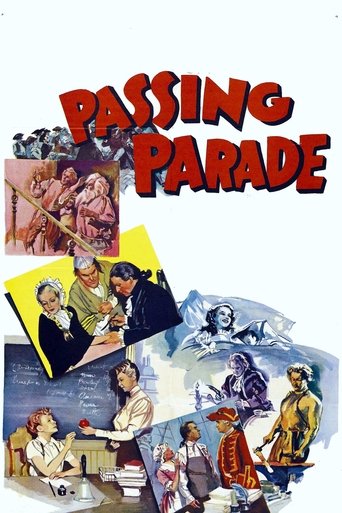
This John Nesbitt's Passing Parade short tells the story of John Peter Zenger, who in Colonial New York was tried for sedition based on what he printed in his newspaper.
Social & External
The people behind it
John Nesbitt
Narrator (voice)
Victor Kilian
John Peter Zenger (uncredited)
Naomi Childers
Courtroom Spectator (uncredited)
Mary Gordon
Woman Reading Newspaper (uncredited)
Edward Hearn
Trooper (uncredited)

John Hubbard
Attorney John Alexander (uncredited)
Carl Stockdale
Hank (uncredited)
This MGM Passing Parade series short recounts how English chemist John Walker invented the wooden friction match during the 1820s.
This short shows how two objects led to important discoveries. Children playing with a seesaw inspire French physician Rene Laennec to invent the stethoscope, and a pair of shoes made of caoutchouc lead Charles Goodyear to discover the process for vulcanizing rubber.
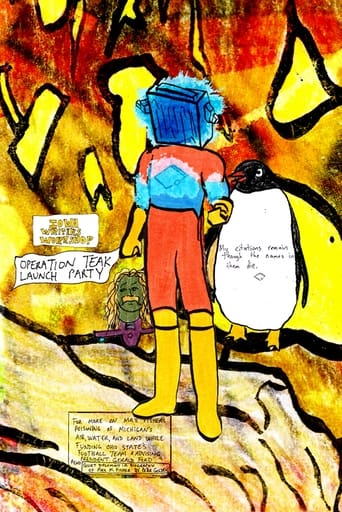
On the 10th anniversary of his band Rall Tide’s debut album, artist Peter Kotas takes you on a flowering multimedia tour of Detroit musicians trying to survive in a world where you can’t even enjoy a baseball game without supporting The Bay of Pigs. Along the way he shows you how the band’s abrupt break-up led to his career as a political journalist peeking behind the curtains of Kansas to find diplomatic wizard Mike Pompeo, Trump’s CIA Director and Secretary of State, wears no clothes. Iowa Writer’s Workshop hero Kurt Vonnegut (or some entity that knows all about his life) hosts this documentary as the ideal human from his 1985 novel Galapagos: a penguin with flippers unable to pull triggers or press buttons to bomb and kill people.
This Passing Parade entry tells the story of Dr. Joseph Goldberger (1874-1929), a Hungarian immigrant who devoted his life to finding the cause of pellagra, a disease that killed hundreds of thousands in the southern United States. Although the medical community believed that the condition was caused by a virus, Goldberger proved that a healthy diet was the cure.
The film is set in 1521 Antwerp, in a Europe ravaged by religious wars, and during the early years of the Reformation. It tells the story of the twelve year old, Falko Voeten – a printer’s son. When Falko’s father, Klaas Voeten, a printer of forbidden literature, is caught by the Inquisition for printing a letter written by Maarten Luther; Falko is unwittingly propelled into helping his father and into searching for the letter. Threatened by the Inquisition but aided by Marieke, a Catholic orphan girl from the underground sewers, Falko is faced with a race against time if he is to save his father from being executed for heresy.
This short film focuses on the mysterious and legendary Seri Indians who live in a utopian colony off the west coast of Mexico.
This short film presents the story of Dr. Ephraim McDowell, who came under scrutiny for his pioneering of surgical practices.
This John Nesbitt's Passing Parade short explores the origins of various customs such as shaking hands, kissing, and why ships are christened.
This MGM John Nesbitt's Passing Parade series short takes a look at the origins of North American slang.
Made just before America would be forced into the Second World War, this short subject is a brief dramatized history of American democracy. It targets a perceived threat to democracy from board room and soapbox fascists who advocated a government based upon contemporaneous European models.
This entry in John Nesbitt's "Passing Parade" series is about the great moments in the lives of famous men who found found an answer or made a great discovery in the flash of a golden hunch.
This MGM Passing Parade series short tells the story of Julian Poydras, whose encounter with a girl at Mardi Gras had a profound effect on his later life.
This Passing Parade series short chronicles the political life of Francisco Madero, who tried to bring democracy and land reform to Mexico.
This MGM Passing Parade series short presents how separate events led to the creation of three provisions - freedom of speech, freedom of the press, and prohibition of the infliction of cruel and unusual punishments - in the U.S. Constitution's Bill of Rights.
Historical short showing how Eli Whitney (best known for the invention of the cotton gin) played a significant role in the introduction of mass production techniques to the USA in the late 18th century.
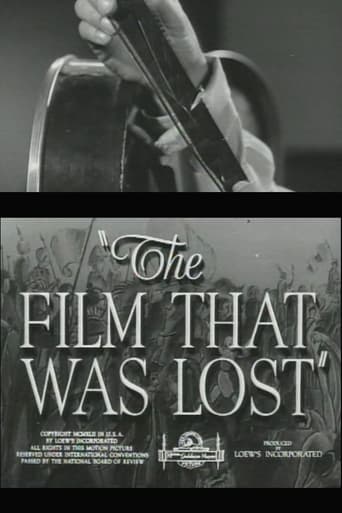
In this John Nesbitt's Passing Parade short, a look is taken at the problems of film preservation efforts in the 1930s and early 1940s.
This John Nesbitt's Passing Parade short takes a look at the typical American barbershop throughout the years.
Americans are preoccupied with the news, but need an escape from many of the events reported in the news. These escapes in the past have included dime store novels. The most accessible of these escapes is what are known as the funny papers, the set of serialized comic strips that are included within many newspapers. They appeal to all socio-economic classes, and all ages. Some of the earliest known from the late 19th century include the Yellow Kid, Little Nemo, Happy Hooligan, the Katzenjammer Kids, Mutt & Jeff, and Bringing Up Father. Many cartoonists are seen in action. Some originated their characters, while others have taken over following the passing of the originator. The joy of many comic strips are the absurd and the fantastical, which are limited only by the imagination of the cartoonist. Others are grounded in reality, which add to their poignancy within the public mindset.
This MGM Passing Parade series short tells the story of Clara Barton, the founder of the Red Cross.
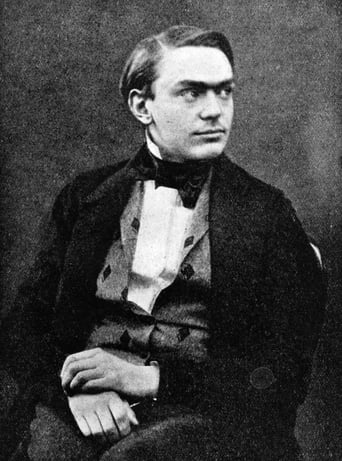
This John Nesbitt's Passing Parade short tells the story of Alfred Nobel, who invented dynamite, and later established the Nobel Prize.
Stephen Glass is a staff writer for the respected current events and policy magazine The New Republic and a freelance feature writer for publications such as Rolling Stone, Harper's and George. By the mid-90s, Glass' articles had turned him into one of the most sought-after young journalists in Washington, but a bizarre chain of events - chronicled in Buzz Bissinger's September 1998 Vanity Fair article - suddenly stopped his career in its tracks.
A WWII veteran escapes his care home in Northern Ireland and embarks on an arduous but inspirational journey to France to attend the 75th anniversary of the D-Day landings, finding the courage to face the ghosts of his past.
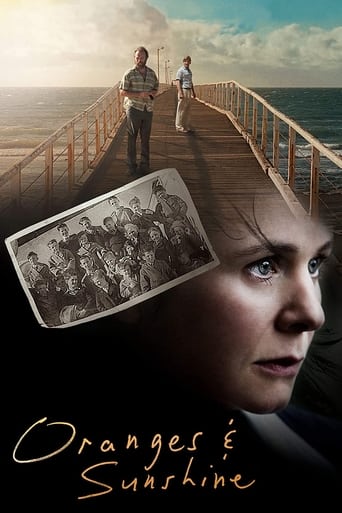
The story of Margaret Humphreys, a social worker from Nottingham, who uncovers one of the most significant social scandals in recent times – the forced migration of children from the United Kingdom to Australia and other Commonwealth countries. Almost singlehandedly, Margaret reunited thousands of families, brought authorities to account and worldwide attention to an extraordinary miscarriage of justice.
A chronicle of the Cristeros War (1926-1929), which was touched off by a rebellion against the Mexican government's attempt to secularize the country.
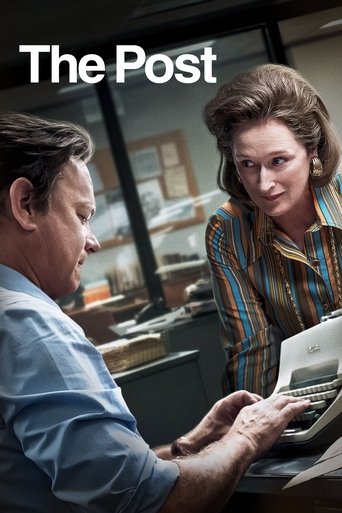
A cover-up that spanned four U.S. Presidents pushed the country's first female newspaper publisher and a hard-driving editor to join an unprecedented battle between journalist and government. Inspired by true events.
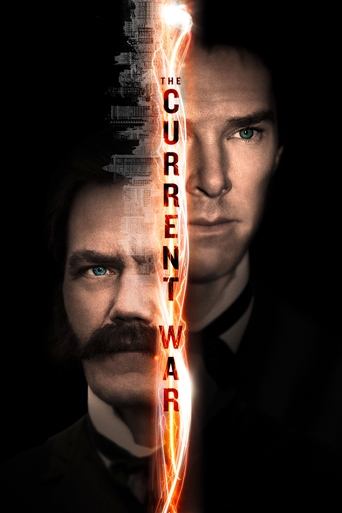
Electricity titans Thomas Edison and George Westinghouse compete to create a sustainable system and market it to the American people.
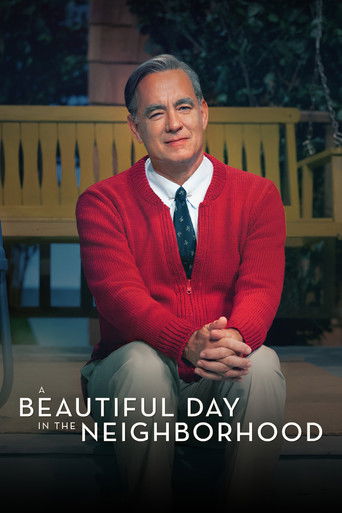
An award-winning cynical journalist, Lloyd Vogel, begrudgingly accepts an assignment to write an Esquire profile piece on the beloved television icon Fred Rogers. After his encounter with Rogers, Vogel's perspective on life is transformed.
Young women toiling in a factory are exposed to hazardous material which takes a disastrous toll on their health.
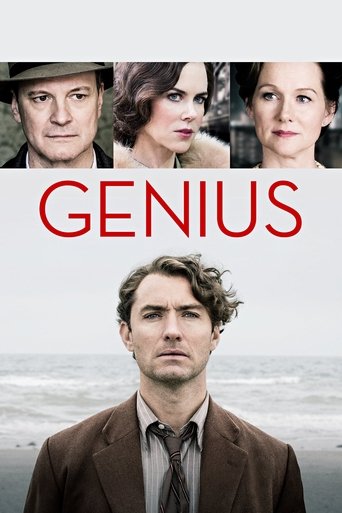
New York in the 1920s. Max Perkins, a literary editor is the first to sign such subsequent literary greats as Ernest Hemingway and F. Scott Fitzgerald. When a sprawling, chaotic 1,000-page manuscript by an unknown writer falls into his hands, Perkins is convinced he has discovered a literary genius.
The story of Rickey Hill, who overcomes his physical disability and repairs his relationship with his father in a quest to become a major league baseball (MLB) player.
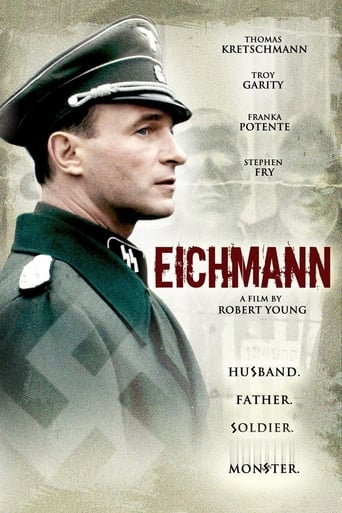
Based upon the final confession of Adolf Eichmann, made before his execution in Israel, of his role in Hitler's plan for the final solution.
The legendary true story of a small band of soldiers who sacrificed their lives in hopeless combat against a massive army in order to prevent a tyrant from smashing the new Republic of Texas.
An amateur historian defies the academic establishment in her efforts to find King Richard III's remains, which were lost for over 500 years.
The story of Ray-Ray McElrathbey, a freshman football player for Clemson University, who secretly raised his younger brother on campus after his home life became too unsteady.
In 1947, Lord Mountbatten assumes the post of last Viceroy, charged with handing India back to its people, living upstairs at the house which was the home of British rulers, whilst 500 Hindu, Muslim and Sikh servants lived downstairs.
Diplomats, soldiers and other representatives of a dozen nations fend off the siege of the International Compound in Peking during the 1900 Boxer Rebellion. The disparate interests unite for survival despite competing factions, overwhelming odds, delayed relief and tacit support of the Boxers by the Empress of China and her generals.
Spain in the 1930s is the place to be for a man of action like Robert Jordan. There is a civil war going on and Jordan—who has joined up on the side that appeals most to idealists of that era—has been given a high-risk assignment up in the mountains. He awaits the right time to blow up a crucial bridge in order to halt the enemy's progress.
The history of cinematic sound, told by legendary sound designers and visionary filmmakers.
As the Japanese surrender at the end of WWII, Gen. Fellers is tasked with deciding if Emperor Hirohito will be hanged as a war criminal. Influencing his ruling is his quest to find Aya, an exchange student he met years earlier in the U.S.
Disgusted with the policies of King Charles I, Oliver Cromwell plans to take his family to the New World. But on the eve of their departure, Cromwell is drawn into the tangled web of religion and politics that will result in the English Civil War.