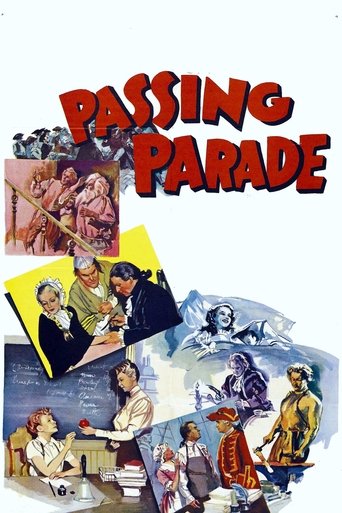
Historical short showing how Eli Whitney (best known for the invention of the cotton gin) played a significant role in the introduction of mass production techniques to the USA in the late 18th century.
Social & External
The people behind it
Lloyd Bridges
Eli Whitney
Erville Alderson
Thomas Jefferson
John Nesbitt
Narrator (voice)
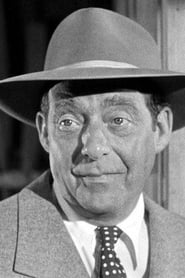
Howard Negley
Military Committee Man (as Howard J. Negley)
Harry Hayden
Senatorial Committee Man
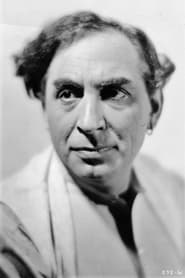
Mitchell Lewis
Eli Whitney's Workman
This John Nesbitt's Passing Parade short takes a look at the typical American barbershop throughout the years.
Americans are preoccupied with the news, but need an escape from many of the events reported in the news. These escapes in the past have included dime store novels. The most accessible of these escapes is what are known as the funny papers, the set of serialized comic strips that are included within many newspapers. They appeal to all socio-economic classes, and all ages. Some of the earliest known from the late 19th century include the Yellow Kid, Little Nemo, Happy Hooligan, the Katzenjammer Kids, Mutt & Jeff, and Bringing Up Father. Many cartoonists are seen in action. Some originated their characters, while others have taken over following the passing of the originator. The joy of many comic strips are the absurd and the fantastical, which are limited only by the imagination of the cartoonist. Others are grounded in reality, which add to their poignancy within the public mindset.
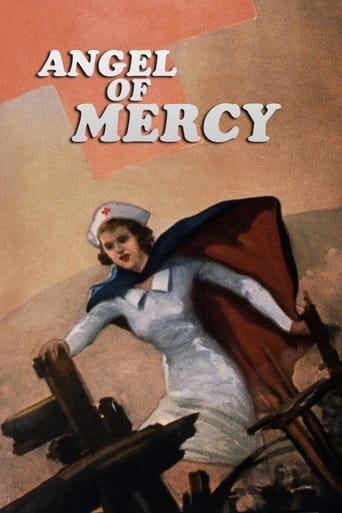
This MGM Passing Parade series short tells the story of Clara Barton, the founder of the Red Cross.
This John Nesbitt's Passing Parade short tells the story of John Peter Zenger, who in Colonial New York was tried for sedition based on what he printed in his newspaper.
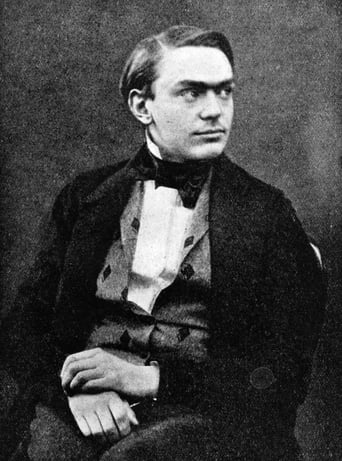
This John Nesbitt's Passing Parade short tells the story of Alfred Nobel, who invented dynamite, and later established the Nobel Prize.
This MGM Passing Parade series short recounts how English chemist John Walker invented the wooden friction match during the 1820s.
This MGM John Nesbitt's Passing Parade series short takes a look at the origins of North American slang.
The saga of the Normandie is recounted from her life as a luxury liner, the horrific fire that nearly destroyed her, and her resuscitation to join in the war effort. A John Nesbitt's Passing Parade short.
In this John Nesbitt's Passing Parade short, a look is taken at the problems of film preservation efforts in the 1930s and early 1940s.
This Passing Parade series short chronicles the political life of Francisco Madero, who tried to bring democracy and land reform to Mexico.
This MGM Passing Parade series short tells the story of Julian Poydras, whose encounter with a girl at Mardi Gras had a profound effect on his later life.
This John Nesbitt's Passing Parade short explores the origins of various customs such as shaking hands, kissing, and why ships are christened.
Made just before America would be forced into the Second World War, this short subject is a brief dramatized history of American democracy. It targets a perceived threat to democracy from board room and soapbox fascists who advocated a government based upon contemporaneous European models.
This short film presents the story of Dr. Ephraim McDowell, who came under scrutiny for his pioneering of surgical practices.
This entry in John Nesbitt's "Passing Parade" series is about the great moments in the lives of famous men who found found an answer or made a great discovery in the flash of a golden hunch.
This entry in MGM's Passing Parade series looks at the meaning of dreams, including one by Abraham Lincoln that foretold his death.
Shows how important luck can be in a person's life.
This MGM John Nesbitt's Passing Parade series short tells the story of how a Mauser pistol used on the battlefield by Germans during WWII makes its way into the hands of an American gangster.
This John Nesbitt's Passing Parade series short highlights the film preservation efforts of the Museum of Modern Art in New York. Several scenes from early newsreels are shown.
This Passing Parade entry tells the story of Dr. Joseph Goldberger (1874-1929), a Hungarian immigrant who devoted his life to finding the cause of pellagra, a disease that killed hundreds of thousands in the southern United States. Although the medical community believed that the condition was caused by a virus, Goldberger proved that a healthy diet was the cure.
Electricity titans Thomas Edison and George Westinghouse compete to create a sustainable system and market it to the American people.
Young women toiling in a factory are exposed to hazardous material which takes a disastrous toll on their health.
Stephen Glass is a staff writer for the respected current events and policy magazine The New Republic and a freelance feature writer for publications such as Rolling Stone, Harper's and George. By the mid-90s, Glass' articles had turned him into one of the most sought-after young journalists in Washington, but a bizarre chain of events - chronicled in Buzz Bissinger's September 1998 Vanity Fair article - suddenly stopped his career in its tracks.
A chronicle of the Cristeros War (1926-1929), which was touched off by a rebellion against the Mexican government's attempt to secularize the country.
Spain in the 1930s is the place to be for a man of action like Robert Jordan. There is a civil war going on and Jordan—who has joined up on the side that appeals most to idealists of that era—has been given a high-risk assignment up in the mountains. He awaits the right time to blow up a crucial bridge in order to halt the enemy's progress.
A WWII veteran escapes his care home in Northern Ireland and embarks on an arduous but inspirational journey to France to attend the 75th anniversary of the D-Day landings, finding the courage to face the ghosts of his past.
The story of Margaret Humphreys, a social worker from Nottingham, who uncovers one of the most significant social scandals in recent times – the forced migration of children from the United Kingdom to Australia and other Commonwealth countries. Almost singlehandedly, Margaret reunited thousands of families, brought authorities to account and worldwide attention to an extraordinary miscarriage of justice.
Crown Prince Rudolf of Austria clashes with his father, Emperor Franz Joseph I of Austria, over implementing progressive policies for their country. Rudolf soon feels he is a man born at the wrong time in a country that doesn't realize the need for social reform. The Prince of Wales, later to become Britain's King Edward VII, provides comic relief. Rudolf finds refuge from a loveless marriage with Princess Stéphanie by taking a mistress, Baroness Maria Vetsera. Their untimely demise at Mayerling, the imperial family's hunting lodge, is cloaked in mystery.
Two young gentlemen living in 1890s England use the same pseudonym ('Ernest') on the sly, which is fine until they both fall in love with women using that name, which leads to a comedy of mistaken identities.
In 1966, Texas Western coach Don Haskins led the first all-black starting line-up for a college basketball team to the NCAA national championship.
Albany, New York, 1776. After marrying, Gil and Lana travel north to settle on a small farm in the Mohawk River Valley, but soon their growing prosperity and happiness are threatened by the sinister sound of drums that announce dark times of revolution and war.
The film follows the journey of Kitty, the imaginary friend to whom Anne Frank dedicated her diary. A fiery teenager, Kitty wakes up in the near future in Anne Frank's house in Amsterdam and embarks on a journey to find Anne, who she believes is still alive, in today's Europe. While the young girl is shocked by the modern world, she also comes across Anne's legacy.
The story of Rickey Hill, who overcomes his physical disability and repairs his relationship with his father in a quest to become a major league baseball (MLB) player.
In 1947, Lord Mountbatten assumes the post of last Viceroy, charged with handing India back to its people, living upstairs at the house which was the home of British rulers, whilst 500 Hindu, Muslim and Sikh servants lived downstairs.
In 1859, idealist John Wickliff Shawnessey, a resident of Raintree County, Indiana, is distracted from his high school sweetheart Nell Gaither by Susanna Drake, a rich New Orleans girl. This love triangle is further complicated by the American Civil War, and dark family history.
Cultural mistrust and false accusations doom a friendship in British colonial India between an Indian doctor, an Englishwoman engaged to marry a city magistrate, and an English educator.
Filmed over 14 months with unprecedented access into the inner circle of the man and the sport, this is the first official and fully authorised film of one of the most celebrated figures in football. For the first time ever, the world gets vividly candid and un-paralleled, behind-closed-doors access to the footballer, father, family-man and friend in this moving & fascinating documentary. Through in-depth conversations, state of the art football footage and never before seen archival footage, the film gives an astonishing insight into the sporting and personal life of triple Ballon D'Or winner Cristiano Ronaldo at the peak of his career. From the makers of ‘Senna’ and ‘Amy’, Ronaldo takes audiences on an intimate and revealing journey of what it’s like to live as an iconic athlete in the eye of the storm.
The sinking of the Titanic is presented in a highly realistic fashion in this tense British drama. The disaster is portrayed largely from the perspective of the ocean liner's second officer, Charles Lightoller. Despite numerous warnings about ice, the ship sails on, with Capt. Edward John Smith keeping it going at a steady clip. When the doomed vessel finally hits an iceberg, the crew and passengers discover that they lack enough lifeboats, and tragedy follows.
The legendary true story of a small band of soldiers who sacrificed their lives in hopeless combat against a massive army in order to prevent a tyrant from smashing the new Republic of Texas.
An amateur historian defies the academic establishment in her efforts to find King Richard III's remains, which were lost for over 500 years.