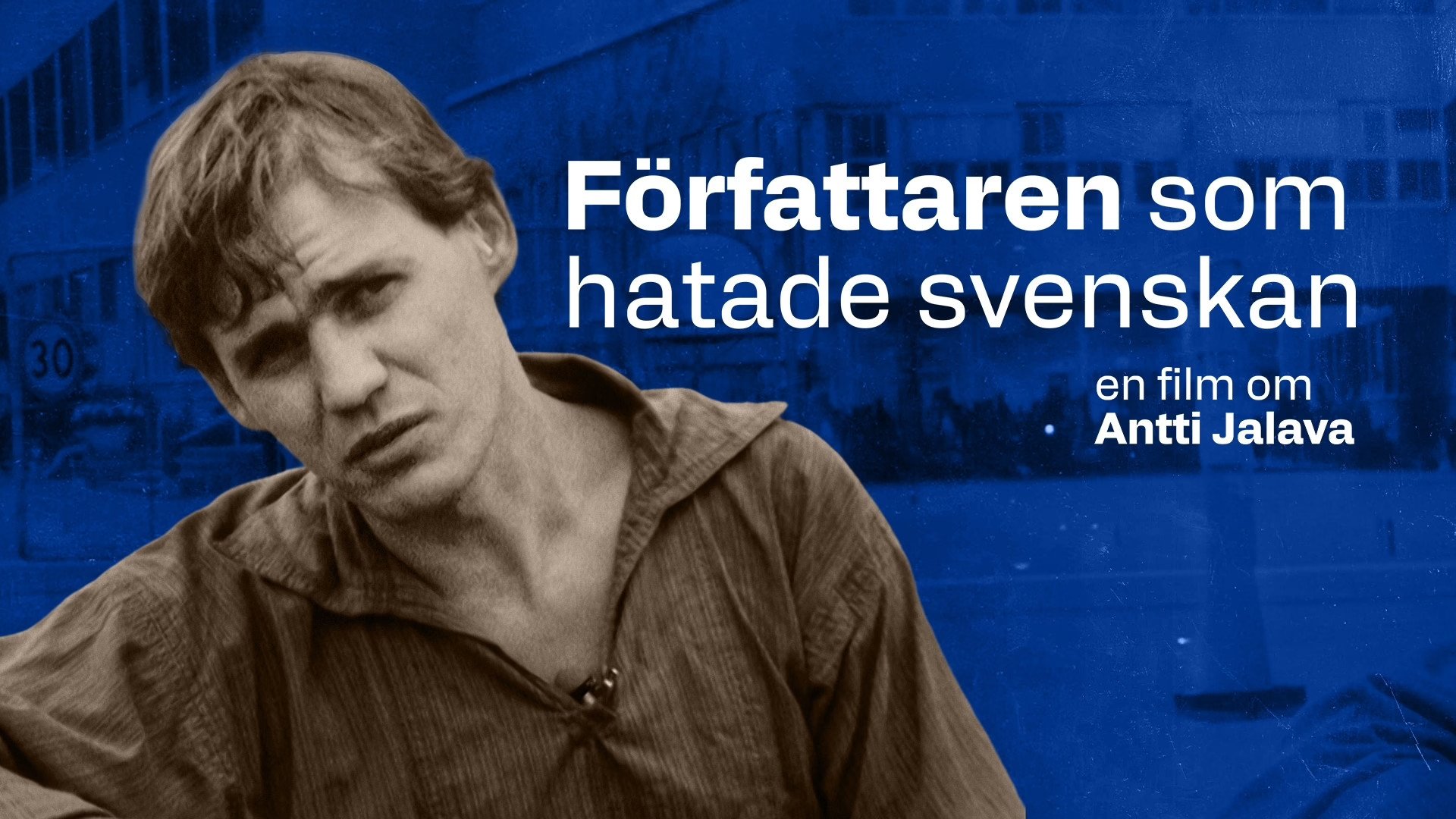
A documentary about Antti Jalava, a Swedish-Finnish writer who was among the first to write about the immigrant experience in Sweden.
Social & External
Self
“An Untitled Film” by George Alshevskij-Jones is a short documentary/visual essay about the struggles of moving to seek a better future in a different country. The research for the film was done by observing and talking to people who have left their home country. It doesn’t matter what country a person has left and in which country he has found himself, the general experiences and emotions stay the same. The most important message that I want the film to convey is that everything is possible and home is not a place on a map, but a place in the soul of each person that I spoke to. The unconventional way of showing many people as one is not just a way of making the film more convenient to create, but a way to fit a much information into one consistent image, that the audience is more likely to understand and perceive as the author intended it. My own experience blended in with the experiences of others.
I was about seven years old the first time someone called me \"black\" on the street. I turned around to see who they were talking to, until I realized they were talking to me.
"Meat Joy is an erotic rite — excessive, indulgent, a celebration of flesh as material: raw fish, chicken, sausages, wet paint, transparent plastic, ropes, brushes, paper scrap. Its propulsion is towards the ecstatic — shifting and turning among tenderness, wildness, precision, abandon; qualities that could at any moment be sensual, comic, joyous, repellent. Physical equivalences are enacted as a psychic imagistic stream, in which the layered elements mesh and gain intensity by the energy complement of the audience. The original performances became notorious and introduced a vision of the 'sacred erotic.' This video was converted from original film footage of three 1964 performances of Meat Joy at its first staged performance at the Festival de la Libre Expression, Paris, Dennison Hall, London, and Judson Church, New York City."
Conductivity is a film about creative leadership told through the story of three young conductors at the prestigious Sibelius Academy in Helsinki, Finland; I-Han Fu (Taiwan), Emilia Hoving (Finland) and James Kahane (France). When stepping on the podium, they are put under a magnifying glass. Conductor training, in essence, is leadership training. The film gives a unique viewpoint to follow the students, as this is the first film about conductor training at the Sibelius Academy.
A documentary by Olivier Gonard, shot partly in Paris’s Musée d’Orsay, that examines Olivier Assayas' film Summer Hours, and its approach to art.
Max Gimblett: Original Mind documents the life and process of eccentric, creative genius Max Gimblett. One of New Zealand’s most successful and internationally prominent living painters, Gimblett has been working in America since 1962. The filmmakers spent a week in Gimblett’s Soho loft where he and his devoted studio assistants generously revealed the techniques and philosophy behind his beautiful art.
70-year-old Timo makes the most of his short ride to work. Speeding up on a bicycle ends up in a ditch, but the adrenaline rush leaves a feeling of pleasure.
Celebrating Billy Connolly's 75th birthday and 50 years in the business, three Scottish artists - John Byrne, Jack Vettriano and Rachel MacLean - each create a new portrait of the Big Yin. As he sits with each artist, Billy talks about his remarkable life and career which has taken him from musician and pioneering stand-up to Hollywood star and national treasure.
Cecil Taylor was the grand master of free jazz piano. "All the Notes" captures in breezy fashion the unconventional stance of this media-shy modern musical genius, regarded as one of the true giants of post-war music. Seated at his beloved and battered piano in his Brooklyn brownstone the maestro holds court with frequent stentorian pronouncements on life, art and music.
When two of artist Barbora Kysilkova’s most valuable paintings are stolen from a gallery at Frogner in Oslo, the police are able to find the thief after a few days, but the paintings are nowhere to be found. Barbora goes to the trial in hopes of finding clues, but instead she ends up asking the thief if she can paint a portrait of him. This will be the start of a very unusual friendship. Over three years, the cinematic documentary follows the incredible story of the artist looking for her stolen paintings, while at the same time turning the thief into art.
This ninety-minute film takes audiences on an epic journey across nine countries and over 1,400 years of history. It explores themes such as the Word, Space, Ornament, Color and Water and presents the stories behind many great masterworks of Islamic Art and Architecture. Narrated by Academy Award winning performer Susan Sarandon, this dazzling documentary reveals the variety and diversity of Islamic art. It provides a window into Islamic culture and brings broad insights to the enduring themes that have propelled human history and fueled the rise of world civilization over the centuries
About Stefan Stricker, who calls himself Juwelia and has been running a gallery on Sanderstraße in Berlin Neukölln for many years. Every weekend he invites guests to shamelessly recount from his life and to sing poetic songs written with his friend from Hollywood Jose Promis. Juwelia has been poor and sexy all her life, has always struggled for recognition, but only partially.
Buenos Aires is a complex, chaotic city. It has European style and a Latin American heart. It has oscillated between dictatorship and democracy for over a century, and its citizens have faced brutal oppression and economic disaster. Throughout all this, successive generations of activists and artists have taken to the streets of this city to express themselves through art. This has given the walls a powerful and symbolic role: they have become the city’s voice. This tradition of expression in public space, of art and activism interweaving, has made the streets of Buenos Aires into a riot of colour and communication, giving the world a lesson in how to make resistance beautiful.
“This is a film about the end of a friendship. It wasn’t meant to be. Fifteen years ago, they painted my portrait.” (Mariano Llinás)
Giuseppina Pasqualino di Marineo, better known as Pippa Bacca, was a 34 years old Italian artist. She crossed 11 countries involved in wars, hitchhiking with another Milanese artist, Silvia Moro, both wearing a wedding dress. This was a performance for peace, trust and hoping to prove that if you rely on others, you’ll receive good things only. After travelling many roads, the two artists decided to split for a while in Istanbul, planning to meet again in Byblos. Pippa left then, alone, and nobody heard from her again.
Jim Moir (aka Vic Reeves) explores Video Art, revealing how different generations ‘hacked’ the tools of television to pioneer new ways of creating art that can be beautiful, bewildering and wildly experimental.
Twenty years ago, novelist Salman Rushdie was a wanted man with a million pound bounty on his head. His novel, The Satanic Verses, had sparked riots across the Muslim world. The ailing religious leader of Iran, the Ayatollah Khomeini, had invoked a little-known religious opinion - a fatwa - and effectively sentenced Rushdie to death. This film looks back on the extraordinary events which followed the publication of the book and the ten year campaign to get the fatwa lifted. Interviews with Rushdie's friends and family and testimony from leaders of Britain's Muslim community and the Government reveal the inside story of the affair.
Documentary film about four families in Pori, Finland, all struggling with unemployment and poverty.