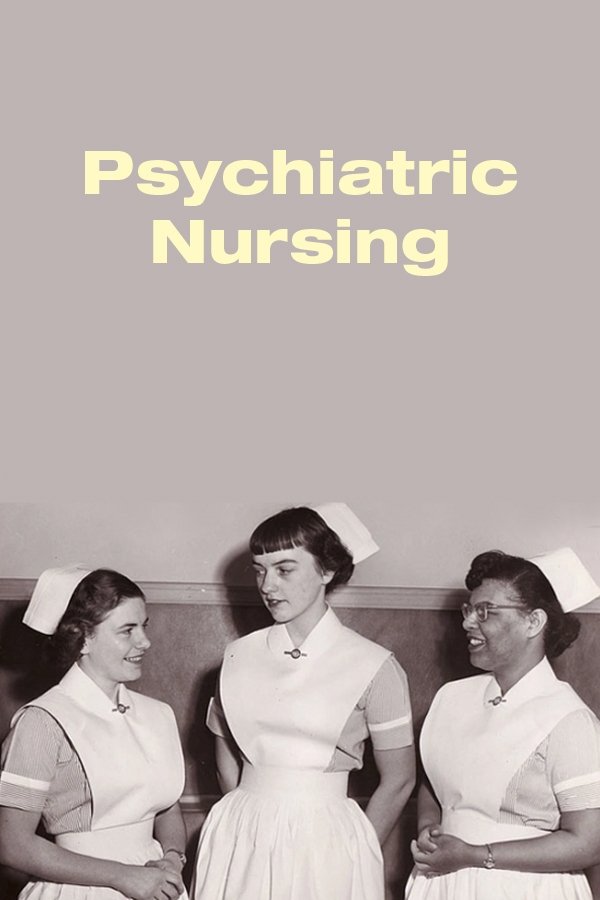
"The Nurse-Patient Relationship"
Psychiatric Nursing: The Nurse-Patient Relationship is a 1958 American documentary film directed by Lee R. Bobker. It was nominated for an Academy Award for Best Documentary Feature.
Social & External
Self - Nurse
Self - Patient
A stark and graphic portrayal of the conditions that existed at the State Prison for the Criminally Insane at Bridgewater, Massachusetts, and documents the various ways the inmates are treated by the guards, social workers, and psychiatrists.
A journey through six different countries and characters into a world where chemistry is the ultimate response to human pursuits of well-being.
The Hugo's Brain is a French documentary-drama about autism. The documentary crosses authentic autistic stories with a fiction story about the life of an autistic (Hugo), from childhood to adulthood, portraying his difficulties and his handicap.
Narrator and director Michael Schaap's confessional style and general goofiness bring levity to an awkward topic: "erectile dysfunction" and the little blue pill that treats it.
Documentary revealing the science behind why so many people find it difficult to nod off, and offering practical tips on the best ways to get a good night's sleep.
More and more doctors and surgeons are using hypnosis as a supplement to anesthesia during surgery. Hypnosis is also gaining increasing recognition among conventional physicians, especially for anesthesia and pain treatment. Can it also help with psychological stress disorders such as trauma, phobias, addiction, depression or burnout?
A short documentary on jazz trombonist, Ryan Porter.
Psychiatrist Dr. Dean Brooks, who appears in the film One Flew Over The Cuckoo's Nest, and others discuss how jails and prisons have become our new asylums and how community care, especially inadequately funded community care, is failing to help people. They also discuss the need for what his granddaughter, Dr. Ulista Brooks, describes as “true asylums” — the construction of new modern mental hospitals, and other important issues regarding care for the mentally ill.
One man's journey to discover the bitter truth about sugar. Damon Gameau embarks on a unique experiment to document the effects of a high sugar diet on a healthy body, consuming only foods that are commonly perceived as 'healthy'. Through this entertaining and informative journey, Damon highlights some of the issues that plague the sugar industry, and where sugar lurks on supermarket shelves.
This compelling film represents a rare record of an original genius. In Jung on Film, the pioneering psychologist tells us about his collaboration with Sigmund Freud, about the insights he gained from listening to his patients' dreams, and about the fascinating turns his own life has taken. Dr. Richard I. Evans, a Presidential Medal of Freedom nominee, interviews Jung, giving us a unique understanding of Jung's many complex theories, while depicting Jung as a sensitive and highly personable human being.
What if science could reverse the aging process? Follow the researchers as they decipher these mechanisms, with the promise of finding the elixir of youth so you can live longer, healthier lives!
Throughout history, the perception of nurses has ranged from wise women to witches, sots to ministering angels, handmaidens to battleaxes. The professional role of the nurse has changed dramatically. Originally the nurse held an independent, curative position in healing the sick. Most of this responsibility has since been lost. In its place, a profession has developed which, while demanding altruism and dedication, is locked into a supportive and secondary role to that of the medical profession.
The psychiatric hospital was and is a disturbing place. Michel Défago, a former nurse, reports on a time when mentally ill people were still shackled or isolated. Today, nurses make every effort to free patients from their suffering and isolation.
The daughters of Title IX discover that pervasive gender-based stereotypes and discrimination persist within the high stakes professional world of surgery - a workplace designed for and and still controlled by men. Since 2003, half of medical students in the US have been women. Women remain in the minority in most surgical fields but their proportion is increasing. Leadership and culture in surgery remain disproportionately and persistently male despite ample evidence that women are just as good (and possibly better) at delivering care. Systemic barriers to success for women surgeons must be confronted and addressed for the surgical workforce to stay healthy and for patients to stay safe. We’ve interviewed dozens of surgeons who are women about their experiences, hopes, dreams and careers. This is a group of extraordinarily dedicated physicians who work every day to improve the health and lives of others despite untold challenges.
An exploration of how the once taboo art form has become socially acceptable.
Six months after a tsunami hit South Asia on December 26, 2004, Muslim-American and Sri Lankan-born Dr. M. Rahmi Mowjood led a team of American doctors and medical students on a relief trip. While mentoring medical students and aiding injured villagers, Dr. Mowjood also finds a way to ask someone to become a member of his own family.
The untold stories of six Australian army nurses who served at the only Australian field hospital in the Vietnam War.
A documentary following 19-year-old Brooke Sturgis, a college student who’s life is flipped upside down after unexpectedly going into heart failure.
Things are busy at the Paris hospital where young psychiatrist Jamal and his colleagues work. The place is run down, the staff are exhausted, budgets are constantly being slashed. You know the story, but you’ve rarely seen it conveyed as engagingly as in ‘On the Edge’, which employs a handheld camera and meaningful, artistic interventions to observe the daily routine at the psychiatric ward. The deeply sympathetic Jamal is an everyday hero with an exemplary, humanistic disposition, for whom the most important prerequisites for mental health – and for a healthy society in general – are good relationships with other people. He puts his philosophy into practice by listening patiently, giving good advice and organising theatre exercises based on Molière. Realism and idealism, however, are in balance for the young doctor, at least as long as the institutional framework holds up.