"It's still men who win coal": a look at the past, present and future of the coal industry.
Social & External
Documentary marking the 30th anniversary of the 1984 miners' strike, one of the bitterest industrial disputes in British history, with stories from both sides of the conflict.
The inside story of Polmaise Colliery and the miners who were the first to walk out and the last to go back to work during the miners' strike.
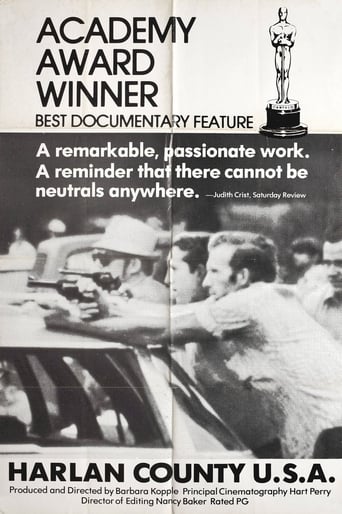
This film documents the coal miners' strike against the Brookside Mine of the Eastover Mining Company in Harlan County, Kentucky in June, 1973. Eastover's refusal to sign a contract (when the miners joined with the United Mine Workers of America) led to the strike, which lasted more than a year and included violent battles between gun-toting company thugs/scabs and the picketing miners and their supportive women-folk. Director Barbara Kopple puts the strike into perspective by giving us some background on the historical plight of the miners and some history of the UMWA. Preserved by the Academy Film Archive in partnership with New York Women in Film & Television in 2004.
The mining industry, which always had been “sponsor” and “financier” of the soccer clubs in the Ruhr valley during the post-war period, doesn’t exist anymore nowadays in that form. Many of the once glorious clubs which dominated German soccer until the 1970s faded into obscurity without financial backers. The documentary “Im Westen ging die Sonne auf" ("The sun had risen in the west“) shows the history of the “Revierfußball” from after the second World War until the decline of the mining industry and recalls legendary players and forgotten clubs. The film shows especially how deeply rooted the sport was back then in the entire lifestyle of the Ruhr area - in private life as well as in society - and how structural change also left clearly visible marks in sports. With pictures from back then, interviews with contemporary witnesses, and footage of original locations nowadays, a contemporary document of German post-war history, by taking the example of soccer, has been created.
This short documentary film is a fascinating portrait of urban and rural Quebec in the late 1960s, as the province entered modernity. The collective work produced for the Quebec Ministry of Industry and Commerce calls on several major Quebec figures.
Thirteen static shots of coal-fired power stations across the United States, seen in rural landscapes, urban settings, sun or cloud and at all times of year. Whatever the location or season, there’s always at least one chimney belching out fumes.
Documents the cultural and ecological impacts of coal stripmining, uranium mining, and oil shale development in Utah, Colorado, New Mexico, and Arizona – homeland of the Hopi and Navajo.
Gold fever has gripped northern Niger. In search of the precious metal, and despite the risks, an army of researchers has invaded the sites of interest. While camps are set up and dismantled as rumours of new leads spread, Moussa and his companions are banking on the Ikazan vein.
A visit to Peterlee, Co. Durham.
Take a revealing tour along a coast of contrasts, from the folksy freshness of Whitby to the coaly Tyne, queen of all rivers.
Mad, bad' poet Lord Byron and a lobster thermidor feature in a melancholy tour of Seaham with Johnny Morris.
A documentary about Nain, a Labrador Inuit community located near the world's largest nickel and copper deposits. As commercial mining interests prepare to exploit the resources, local residents consider the potential environmental and cultural impact. Meanwhile longstanding Aboriginal land claims are unsettled.
An insight into the lives of the miners who search for Australia’s famous black opals.
A film about the first benefit rock concert when major musicians performed to raise relief funds for the poor of Bangladesh. The Concert for Bangladesh was a pair of benefit concerts organised by former Beatles guitarist George Harrison and Indian sitar player Ravi Shankar. The shows were held at 2:30 and 8:00 pm on Sunday, 1 August 1971, at Madison Square Garden in New York City, to raise international awareness of, and fund relief for refugees from East Pakistan, following the Bangladesh Liberation War-related genocide.
Brought by poverty, Petang and Cereno are driven into the realm of child labor to live by the clock. Film Weekly follows their journey as they step back to breathe and to be children once again.