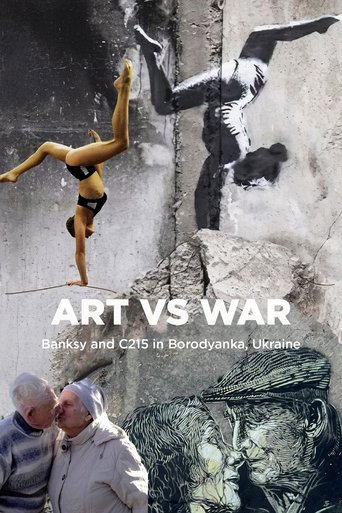
Abel Ferrara explores human conflict and the search for peace and balance through the music and words of Patti Smith and the experiences of people at war in Ukraine.
Social & External
Unknown Role
Self (archive footage)
A documentary film-project by Dmytro Komarov. He was the first journalist to witness and film the horrors of the just-liberated towns of Bucha, Irpin and Hostomel. He saw the first emotions of people immediately after the de-occupation of Kyiv region, Kharkiv region, and Kherson region. The documentary is the author's view of the war from angles that you won't see in the news. Unique, rare, exclusive comments from those whose hands and minds are shaping our future victory. The main heroes of documentary are both ordinary Ukrainians who heroically show their strength and power every day for a year and high-ranking officials such as Minister of Defense of Ukraine Oleksiy Reznikov, Chief of the General Staff of the Armed Forces of Ukraine Kyrylo Budanov, Major General Oleksandr Syrskyi, Commander of the Air Force of the Armed Forces of Ukraine Lieutenant General Mykola Oleshchuk. Initially, "Year" was a series of journalistic reports, later they were edited into a two-part film.
Clive Myrie travels across Ukraine to meet musicians who are preparing to leave their families in their war-torn country in order to create an orchestra and perform at the Royal Albert Hall. With only ten days to rehearse, can they succeed in their ambition to fight the war with their music, instead of with guns? And will the concerts touch the world in the way that they hope?
Four journalists talk about their experiences and share their testimonies of the Russian invasion of Ukraine.
Russia's full-scale invasion of Ukraine has changed the lives of every Ukrainian. Formerly bankers, IT workers, cultural figures and others have become military personnel and volunteers, people resisting the greatest threat to peaceful life in all of Europe.
A montage of newscasts tracing the events of the "damned war" and the German invasion of 1940.
They are just 20 years old and are fighting against the Islamic State in the Syrian Kurdish regions. In a region of the world where women normally have to walk three steps behind men, the fact that they are under arms together with their brothers is of particular significance. Their colorful scarves and their courage have made them famous.
A family with five children flees the war raging in their home village on the Russian border. They end up in Mshanets, a farming village on the other side of the country, remote and unknown. Here the family starts building a new home. At the same time, two documentary makers come to the village, looking for a story. In the Lymar family they find the ideal characters for their film. But one day, when the renovation of their house is almost finished, the family disappears. The filmmakers go in search of their characters and along the way they try to find an answer to the question: what does a person need to feel at home?
Between June 1940 and August 1944, Otto Abetz, German ambassador in Paris, and Fernand de Brinon, ambassador of the Vichy regime in Paris, met almost daily and developed official collaboration between the governments of Vichy and Nazi Germany.
Witnesses discuss the Ascq massacre by the Waffen-SS during the Second World War 80 years later.
Lugansk region, May 2014. The Novozhilov family, by chance, finds itself in the thick of events in Lugansk. Vlad Novozhilov is a former participant in the war in Afghanistan. He knows firsthand what war is. Having seen enough of the horrors of war in his time, in principle he does not even want to touch a weapon. In a situation, he sees only one way out - to leave the country. But you can't run away from the war, the border is already closed. To save his family, he will have to make difficult moral choices.
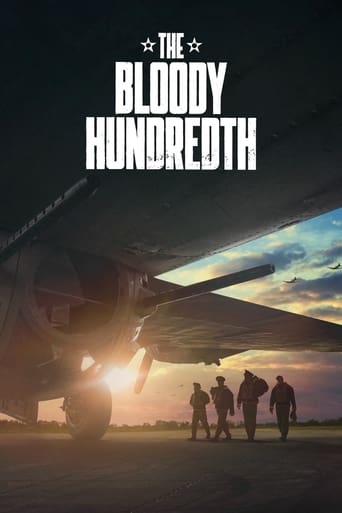
Meet the real-life airmen who inspired Masters of the Air as they share the harrowing and transformative events of the 100th Bomb Group.
Archival footage, animation and music are used to look back at the eight anti-war protesters who were put on trial following the 1968 Democratic National Convention.
This documentary posits that war and confrontation between superpowers spell doom for humanity. A film warning about all aspects of nuclear danger.
In 2014, the war begins. Immediately, a system of evacuation of the wounded and killed is being built, the outpost of which is the Dnieper - it is here that the first will be delivered, it is here that they are still received. Tatiana Guba has been coordinating the evacuation for 5 years. She is called "Mom Tanya". Thousands of people are grateful to her for her life. Serhiy Kryvorotchenko, director of the Dnipro Airport, has deployed a helicopter evacuation system since the beginning of the war. Eugene Titarenko, the film's director, in 2014-2015 was part of a volunteer medical battalion, communicates with the heroes of the film about the evacuation system. The viewer will see the whole way of saving lives, will be directly in the vortex of events and will understand how many people are involved in the process of saving one person.
The story is not only about Ukrainian museums during a full-scale war, but about the survival of our culture in general. The occupiers are trying to destroy it and steal it, but thanks to museum workers, it is not only being protected, but also multiplied.
Director, choreographer, actress, singer – the usual professional roles for the heroines of this film stopped working at the beginning of Russia’s full-scale invasion of Ukraine. Like millions of Ukrainian men and women, who were saving themselves and their loved ones and volunteering. Creative pursuits returned later, but now in a new dimension. Iryna, Olena, Oksana, and Maryna became the voices that tell the world about Ukrainians, their culture and their struggle for freedom. But how can one be heard in a world where Russian propaganda has been spread for centuries?
In 1943, Noor Inayat Khan was recruited as a covert operative into Winston Churchill's Special Operations Executive. With an American mother and Indian Muslim father, she was an extremely unusual British agent. After her network collapsed, Khan became the only surviving radio operator linking the British to the French Resistance in Paris, coordinating the airdrop of weapons and agents, and the rescue of downed Allied fliers.