Social & External
Maestra (Voice)
Enrique Mosca (Voice)
Periodista (Voice)
Agustín Araya (voice)
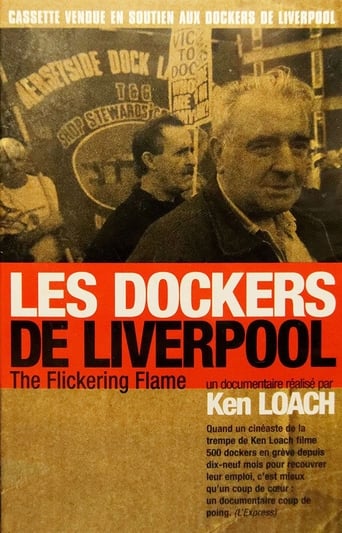
Documentary following dockers of Liverpool sacked in a labour dispute and their supporters’ group, Women of the Waterfront, as they receive support from around the world and seek solidarity at the TUC conference.
Departing from peripheral details of some paintings of the Bilbao Fine Arts Museum, a female narrator unravels several stories related to the economic, social and psychological conditions of past and current artists.
A RECORD OF THE STRIKE AT GRUNWICK IN 1977. The story of the continuing struggle at Grunwick’s by mainly Indian workers, from July 11th, 1977 until the struggle was lost. It shows the Special Patrol Group attack on the November 7th day of action, how the leadership of the struggle was taken out of the hands of the strike committee, how some of the strike leaders were disciplined by their own union for going on hunger strike outside the TUC in protest at the TUC’s inactivity, and how the post office workers were forced by their union to end their blacking of Grunwick mail. It also shows the beginnings of the similar struggle by immigrant workers at Garner’s Steak Houses in London.
'Stand together!', a film on the "mass day of solidarity" on 11 July 1977, was made in 1977 for the Grunwick Strike Committee by the Newsreel Collective, of which Chris Thomas was a member, and members of the Association of Cinematograph, Television and Allied Technicians (ACTT) and the Transport and General Workers' Union.
Warsaw's Central Railway Station. 'Someone has fallen asleep, someone's waiting for somebody else. Maybe they'll come, maybe they won't. The film is about people looking for something.
When workers at the Hormel meatpacking plant in Austin, Minnesota are asked to take a substantial pay cut in a highly profitable year, the local labor union decides to go on strike and fight for a wage they believe is fair. But as the work stoppage drags on and the strikers face losing everything, friends become enemies, families are divided and the very future of this typical mid American town is threatened.
This film documents the coal miners' strike against the Brookside Mine of the Eastover Mining Company in Harlan County, Kentucky in June, 1973. Eastover's refusal to sign a contract (when the miners joined with the United Mine Workers of America) led to the strike, which lasted more than a year and included violent battles between gun-toting company thugs/scabs and the picketing miners and their supportive women-folk. Director Barbara Kopple puts the strike into perspective by giving us some background on the historical plight of the miners and some history of the UMWA. Preserved by the Academy Film Archive in partnership with New York Women in Film & Television in 2004.
In 1977, Silvia Suppo was kidnapped and raped under the last Argentine civil-military dictatorship. As a consequence, she became pregnant, and the repressors performed an abortion on her "to correct the mistake." In 2009, her testimony was key to achieving the first conviction for crimes against humanity of a federal judge, Víctor Brusa, and his task force. Three months later, she was brutally murdered in her shop in Rafaela (Santa Fe / Argentina). Today her murder remains unpunished. This documentary reconstructs Silvia in the dimension of her woman, mother and friend, in her political character and in her sensitivity, so that we all know her cause. We seek a truth that does justice to her death and rescues her, above all, the value of her life.
At the end of the last civil-military dictatorship, a camouflage operation took place in the Information Service, an office of the former Rosario Police Headquarters that operated as a clandestine detention center in the heart of the city. This architectural intervention, not recorded in the plans, obscures the survivors' accounts and hides the traces of crimes against humanity. Drawing on images, previously unpublished archives, and survivor testimonies, the documentary explores the scars of political repression and highlights the importance of preserving memorial spaces to ensure the transmission of fundamental events in our contemporary history.
A film documenting work shortages during the Depression of the 1930s and the attempts to deal with the unemployed, in particular young men. The film discusses the establishment of relief camps and projects, where men were paid twenty cents per day; the founding of organizations such as the Co-operative Commonwealth Federation (CCF), Workers' Unity League, and Relief Camp Workers' Union; general unionization and protest of the unemployed, including the On To Ottawa Trek, Regina Riot, sit-in strike from May to June 1938 at the Vancouver Main Post Office, Vancouver Art Gallery and Hotel Georgia, and the resulting Bloody Sunday of June 19.
In May 1968, workers, students and young people rise up against the morality and power of the establishment. Faculties and factories are under occupation. Barricades are erected. Paving slabs are launched. Words give way to actions. This is the confrontation. These images bear witness to the men and women who, in their indignancy, march towards their revolution. 50 years ago, as part of our ARC collective, we filmed the uprising of May and June 1968. Out of this material and scenes borrowed from our other filmmaker friends, we created this film.
A place with stairs, but that leads to walls. A place with lots of space, but no one fights for it. And a place with lots of owners, but so empty that no one wants to enter.
A double-edged letter in the midst of confinement. Javier starts sending videos to his son to catch him up on his new life. Through these videos, Nico will try to respond to his father.
Leticia was 17 years old when she was kidnapped from school. She had arrived in Cipolletti a year earlier from the Vicente López National School in Buenos Aires. This letter was found while searching for photos and testimonies from those days.
This remarkable new documentary explores the story behind one of the most iconic images of the twentieth century: the 1932 photograph of workmen taking their lunch while perched on a girder high above New York City.
"Don't Let The Bastards Grind You Down" is a documentary film about British social policy. The focus is on the political struggle against neoliberal austerity policies, which have their origins in the hated Thatcher government. The film features the former socialist MP Dave Nellist, who is now the national chair of the Trade Unionist & Socialist Coalition and Hannah Sell, the general secretary of the Socialist Party. The film features a local election campaign in the miners' town of Nuneaton, students campaigning against an increase in tuition fees and refuse workers from Birmingham striking against massive cuts to their wages.
November 2017, North of Paris : H. Reiner-Onet cleaning company workers are fighting an exemplary battle. This 45 days strike, one of the longest in the history of the French railway, led by these men and women, ended in a decisive victory against two giants, Onet and the SNCF. One of the most impoverished sectors among railway workers, they had no previous experience with striking or organized struggle. How did they pull such a victory ? Their dermination to fight was undoubtedly the key to winning, but so are the links they forged with revolutionary activists who brought with them a tradition of fighting for workers against employers.