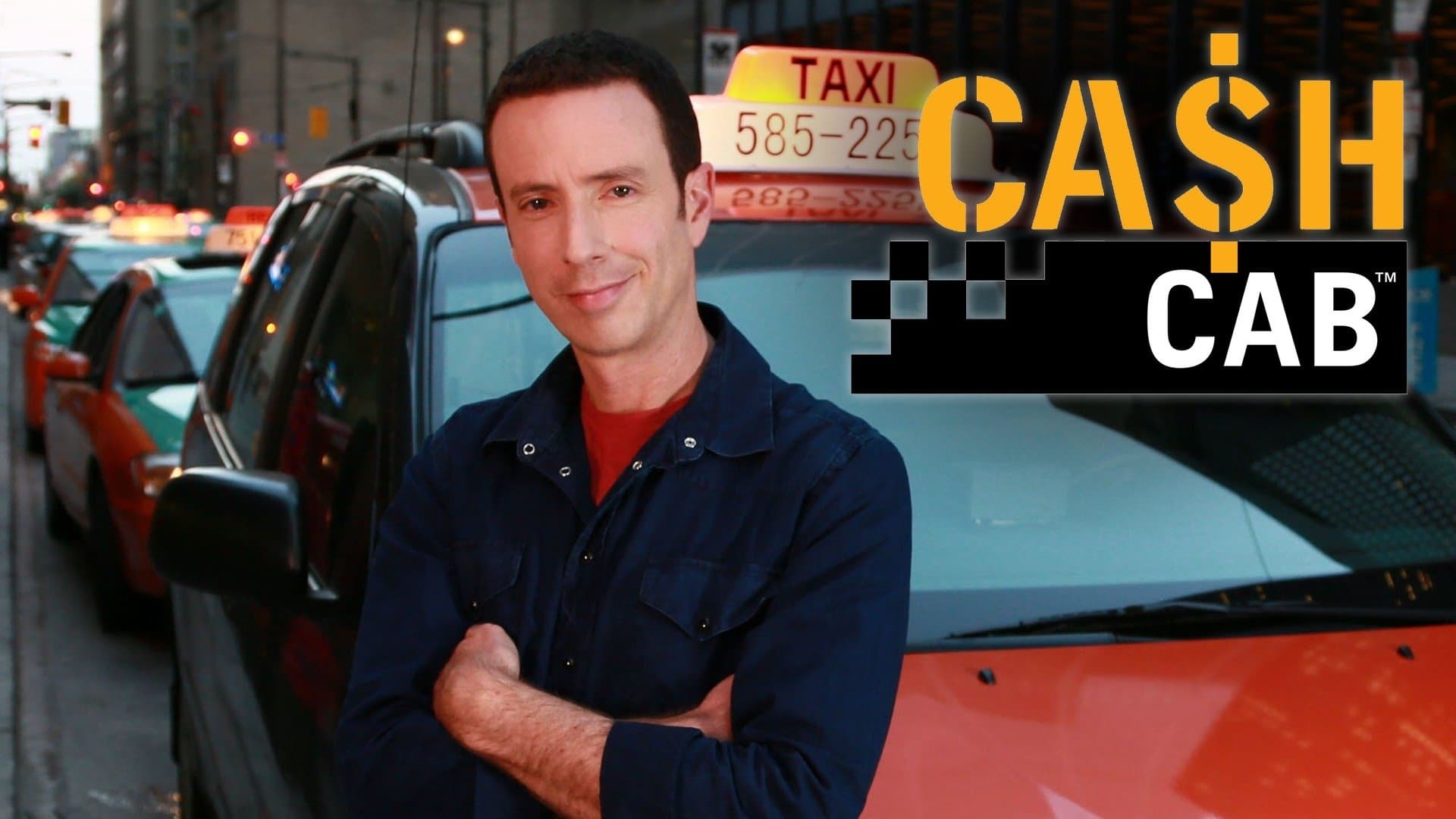
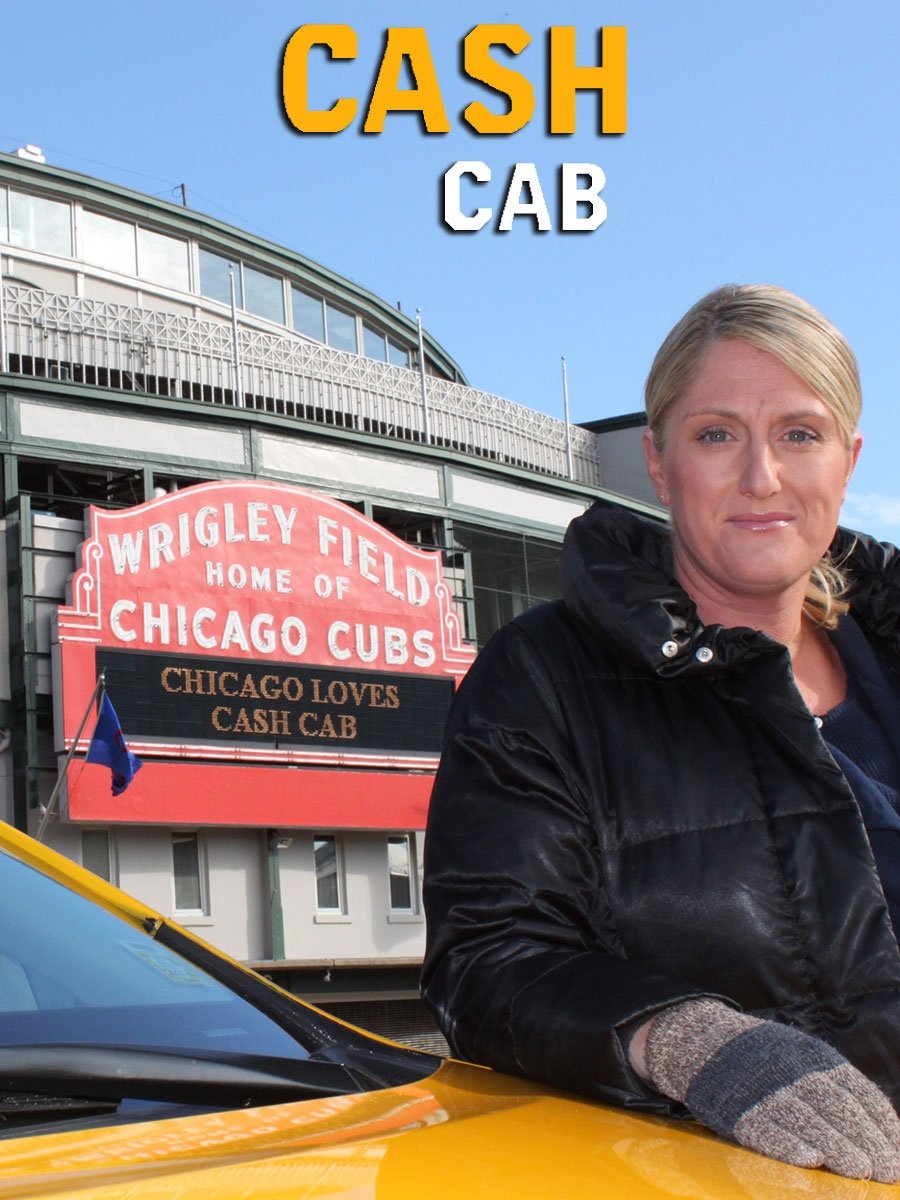
Cash Cab: Chicago is a spin-off series, hosted by comedian Beth Melewski, and using the same rules as its New York counterpart. The series was cancelled after one season.

Social & External
Host
Card Sharks is an American television game show created by Chester Feldman for Mark Goodson-Bill Todman Productions. Two contestants compete for control of a row of oversized playing cards by answering questions posed by the host and then guessing if the next card is higher or lower in value than the previous one. The concept has been made into a series four separate times since its debut in 1978, and also appeared as part of CBS's Gameshow Marathon. The primary announcer for the first three series was Gene Wood.
Game$how Marathon is an American television program which aired on CBS from May 31, 2006 to June 29, 2006. It is based on the UK series Ant & Dec's Gameshow Marathon which aired on ITV in 2005. The show features contestants competing in some of television's most historically popular game shows, in a single-elimination format until an ultimate winner is found. Both the UK and US versions featured celebrity contestants. The US version was produced by FremantleMedia North America and Granada America and was hosted by Ricki Lake and announced by Rich Fields. In the US, the series only aired for a single season, while in the UK a second season aired in 2007, this time entitled Gameshow Marathon and hosted by Vernon Kay. This program was recorded at Stage 46, CBS Television City in Los Angeles, CA, USA.
Sporting quiz show, with regular captains leading teams of celebrities.
Host Jeremy Dooley pits a contestant against a panel of deceivers. It's up to them, and you–the audience–to figure out who's lying, who's telling the truth, and who's a CHUMP.
In this daily game show hosted Pierre Hébert, two contestants and the studio audience are asked to answer offbeat questions that play on people’s preconceived ideas and perceptions about four guest stars on the set.
Stephen Mulhern hosts this remake of the 1980's game show where contestants have to guess a catchphrase based on animated picture clues. The puzzle is revealed one square at a time. It could be a book, a movie or a catch phrase. The winner with the most money can go on to win up to £50,000.
The table is set for the ultimate culinary clash in this one part cooking competition, one part game show. Host Adam Richman ("Man v. Food") will give homegrown amateur cooks the chance to test their skills against professional chefs. Every down-home cook has that one signature dish or secret family recipe that always gains favor with friends and family. Now, imagine going head-to-head in the kitchen against five professional chefs, who try to cook your specialty dish even better than you in the hopes of winning over a dinner party made up of the American public. With each savored victory, the cash prize gets bigger and bigger as the home cooks rise to every challenge and outcook the professional chefs. Think you've got what it takes to serve up the competition?
Singing competition in which celebrities face off against one another while shrouded from head to toe in an elaborate costumes, concealing their identities.
Catchphrase is a British game show based on the short-lived U.S. game show of the same name. It originally aired on ITV in the United Kingdom between 12 January 1986 and 19 December 2002. It was presented by Northern Irish comedian Roy Walker from 1986–1999; followed by Nick Weir from 2000–2002, and Mark Curry in 2002. In the original series, two contestants, one male and one female would have to identify the familiar phrase represented by a piece of animation accompanied by background music. The show's mascot, a golden robot called "Mr. Chips", appears in many of the animations. In the revived version of the show, the same format remains, but there are three contestants. In August 2012, it was announced that Stephen Mulhern would host a revived version of the show beginning on 7 April 2013. On 21 August 2013, it was confirmed that Catchphrase has been re-commissioned for a second series, following the success of the first.
Shooting Stars is a British television comedy panel game broadcast on BBC Two as a pilot in 1993, then as 3 full series from 1995 to 1997, then on BBC Choice from January to December 2002 with 2 series before returning to BBC Two for another 3 series from 2008 until its cancellation in 2011. Created and hosted by double-act Vic Reeves and Bob Mortimer, it uses the panel show format but with the comedians' often slapstick, surreal and anarchic humour does not rely on rules in order to function, with the pair apparently ignoring existing rules or inventing new ones as and when the mood takes them.
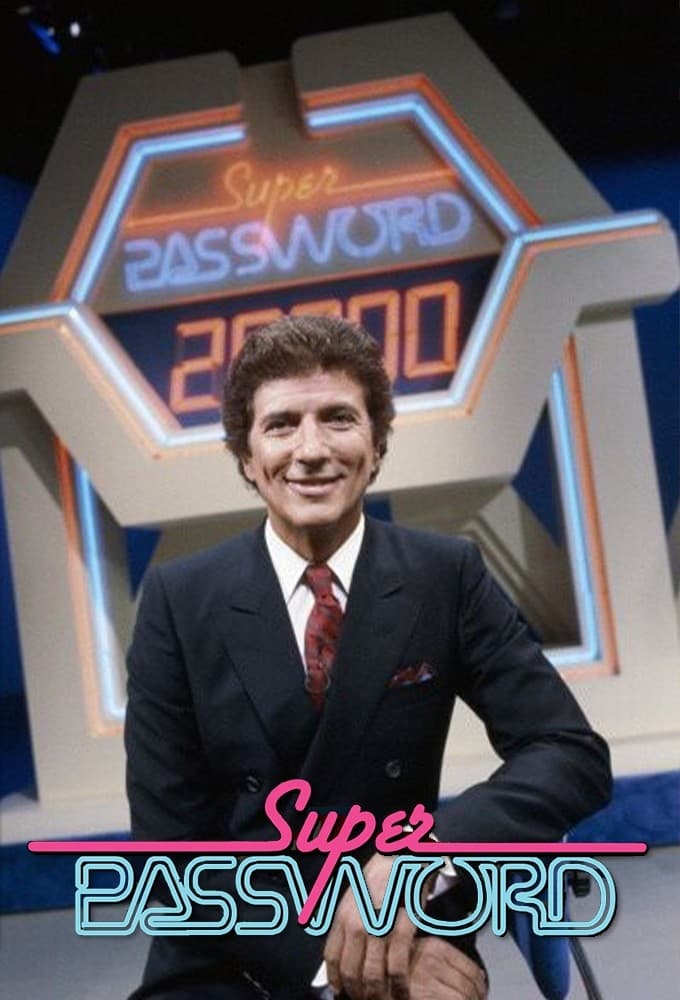
Super Password is an American game show, hosted by Allen Ludden, Bill Cullen and Tom Kennedy, that aired on NBC from aired from January 8, 1979 to March 26, 1982.
Ellen DeGeneres, along with her celebrity friends, delivers incredible gifts to unsuspecting people who’ve topped her nice list.
Based off of American game show Family Feud, hosted by Johnson Lee.
Concentration is an American television game show based on the children's memory game of the same name. Matching cards represented prizes that contestants could win. As matching pairs of cards were gradually removed from the board, it would slowly reveal elements of a rebus puzzle that contestants had to solve to win a match. The show was broadcast on and off from 1958 to 1991, presented by various hosts, and has been made in several different versions. The original network daytime series, Concentration, appeared on NBC for 14 years, 7 months, and 3,770 telecasts, the longest run of any game show on that network. This series was hosted by Hugh Downs and later by Bob Clayton, but for a six-month period in 1969, Ed McMahon hosted the series. The series began at 11:30 AM Eastern, then moved to 11:00 and finally to 10:30. Nearly all episodes of the NBC daytime version were produced at 30 Rockefeller Plaza, New York City. A weekly nighttime version appeared in two separate broadcast runs: the first aired from October 30 to November 20, 1958 with Jack Barry as host, while the second ran from April 24 to September 18, 1961 with Downs as host.
Bad Influence! is an early to mid-1990s British factual television programme broadcast on CITV between 1992 and 1996, and was produced in Leeds by Yorkshire Television. It looked at video games and computer technology, and was described as a "kid’s Tomorrow's World". It was shown on Thursday afternoons and had a run of four series of between 13 and 15 shows, each of 20 minutes duration. For three of the four series, it had the highest ratings of any CITV programme at the time. Its working title was Deep Techies, a colloquial term derived from 'techies' basically meaning technology-obsessed individuals.
Wheel of Fortune is a British television game show created by Merv Griffin. Contestants compete to solve word puzzles, similar to those used in Hangman, to win cash and prizes. The title refers to the show's giant carnival wheel that contestants spin throughout the course of the game to determine their cash and/or prizes. The programme aired between 19 July 1988 and 21 December 2001 and was produced by Scottish Television for the ITV network and mostly follows the same general format from the original version of the programme from the United States.
1985: Greenpeace ship Rainbow Warrior is bombed. The attack exposed a murky world of nuclear testing and abuse of power - and inspired a generation of environmental activists.
Bobby Generic lives in a typical suburban neighborhood and uses his overactive imagination to discover a world of daring adventure, incredible wonder and lots of laughs — all in pint-sized perspective.
A story that follows two couples who mistakenly find themselves in a marriage they never expected and gradually grow in love and trust over time.
Tang Ying, a junior lawyer going through a tough time meets a young man called Xu Ziquan. Things happen and the two end up pretending to date.
A department store mogul has his son work incognito in a menial job to prove his worthiness, while female co-workers teach him how normal people live.
The Amazing Chan and the Chan Clan is a 1972 TV series made by Australia's Eric Porter Studios for American Hanna-Barbera Studios and CBS. It premiered shortly after what would have been Charlie Chan creator Earl Derr Biggers' 88th birthday. The voice of Mr. Chan, Keye Luke is the only actor of Chinese ancestry to play the title character in any screen adaptation.
A former samurai, a yakuza bodyguard, a devious spy, and a geisha assassin try to find their place in the rapidly evolving Meiji-era while escaping the sins of their pasts.
The show chronicles the love story of Arzoo, who values truthful relationships, and Sahir, who is caught between his affection for Arzoo and nostalgia for his comatose wife.
Porsche is in danger of having his school club for taking care of stray cats and dogs shut down, by the school's Dean. So Porsche and his best friend, Pik, try to recruit Emma and her best friend, Rome. This is because Emma's uncle is the Dean. The catch--Emma loves cats but is terribly afraid of dogs. Will this be the end of Porsche's dog and cat club or the start of a beautiful friendship between everyone? Or maybe even more?
From relative obscurity and a seemingly normal life, to overnight success and thrust into the Hollywood limelight overnight, the D’Amelios are faced with new challenges and opportunities they could not have imagined.
It might be one of the most famous continents on the planet, but the story of Australia hasn't been told quite like this before. In a four-part world premiere blue-chip wildlife series, come face-to-face with Australia’s most iconic – and most mysterious – animals including the cassowary, tree-kangaroo, dingo, echidna and platypus as they soar, swim and stalk through the unspoiled and spectacular environment.
Bear Grylls takes a celebrity on a mission to test their survival skills.