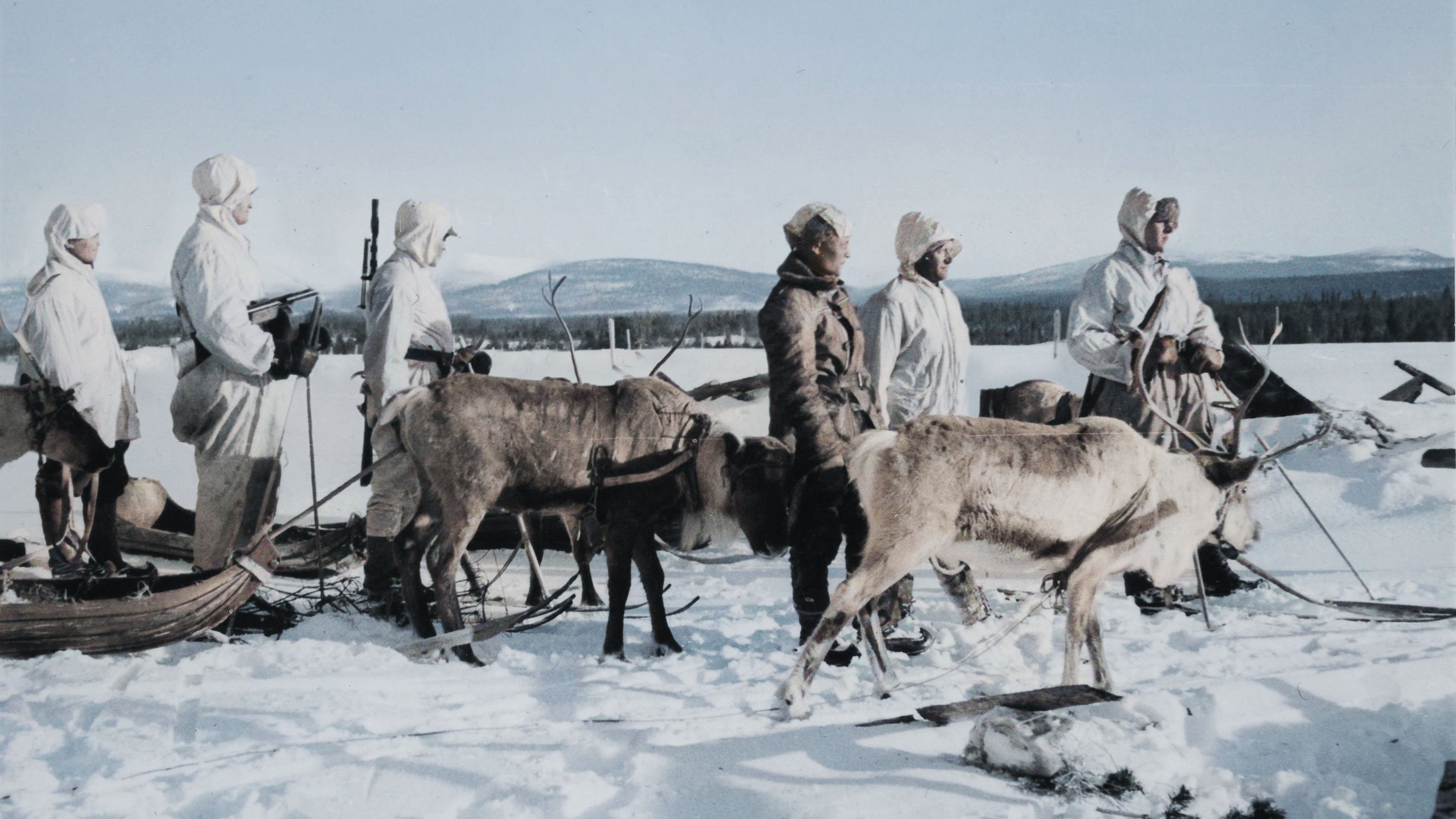
A six-part documentary series about the least known events of World War II. The series reveal a little-known picture and countless unknown details of the events of World War II in the north.

Social & External
Adolf Hitler pretended to be poor but amassed a huge private fortune. The Führer may have believed he was Jewish. Rigorously fact-checked revelations throw a genuine new light on the Nazi regime.
This 9-episodes documentary series extensively examines the history of Poland in the 20th Century, telling the story through archival films, newsreels, interviews, and readings from novels and poems.
The story of the biggest seaborne invasion in history, told using a treasure trove of rare and previously unheard recordings of those who lived through it, lip-synched by actors.
What was Finlandization? What did lying to oneself do to a nation? How low did Finland grovel in the mud and what was all that was necessary? Or was it a success story, because independence was preserved? The series takes us from the end of the World War to the 1990s. It focuses on the 1970s, with its 'Taistoists' and its liturgies of friendship, as well as on the role played by Finnish Broadcasting Company and other media in the Finlandization process.
The story of Hitler’s war on the Eastern Front – an attempt to liquidate the Russian people and gain living space for his superior Aryan race. It is a conquest that takes the Nazis all the way to the gates of Moscow and back to the heart of Berlin, and culminates in the collapse of the Third Reich. The series reveals the cunning strategy, defensive megastructures and military technology deployed in this devastating war of brutality between giants.
WWII history series following a four-man team as they explore the war zones of the Eastern Front in an effort to excavate and preserve the forgotten battle relics, at the same time discovering the stories of fallen soldiers from their remains.
The three-part miniseries chronicles the life of Franklin D. Roosevelt, the thirty-second President of the United States.
A three-part insight into an amazing wartime mission in Norway, undertaken in the early 1940s, which was immortalised by the Hollywood movie The Heroes of Telemark.
Diaries, correspondence and family film recordings reveal a unique view of the life and privacy of the citizens of the so-called Protectorate of Bohemia and Moravia… Young documentarian Ondřej Veverka approached dozens of witnesses of the protectorate times and their descendants to share unique film recordings and written testimonies with him from that time. The result is a three-part documentary that provides a unique perspective on the protectorate. At that time, perhaps more than ever, amateur cameras noticed ordinary everyday things, small joys and ordinary life. Perhaps so that one can at least for a moment succumb to the illusion that the world is actually still in order. But soon tragedy entered these shots as well.
The Valiant Years was a documentary produced by ABC based on the memoirs of Winston Churchill, directed by Anthony Bushell and John Schlesinger, narrated by Gary Merrill and with extracts from the memoirs voiced by Richard Burton. It ran in the United States from 1960 to 1961, in 27 30-minute episodes and was broadcast in the UK by the BBC from February to August 1961. Its incidental music was written by Richard Rodgers, who won an Emmy for it in 1962. Scriptwriters included Victor Wolfson a dramatist and writer, Quentin Reynolds, William L. Shirer an American journalist, war correspondent and historian, and Richard Tregaskis. One of the program's London-based producers was actor Patrick Macnee, just prior to his being cast as secret agent John Steed in the long-running cult TV series The Avengers.,
Using witness testimony, archive and archaeological evidence, this three-part series reveals the untold story of the preparations to defend World War Two Britain by the Home Guard.
Dwight D. Eisenhower, John F. Kennedy, Lyndon B. Johnson, Richard Nixon, Gerald Ford, Jimmy Carter, Ronald Reagan and George H.W. Bush. This is the story of how their war experiences change them, how they emerge from conflict as leaders and how the crucible of war shapes the decisions they make when they reach the White House.
6 June 1944. A titanic fleet launched an assault on the beaches of Normandy. Objective: to liberate Europe from Hitler's yoke. Drawing on the lessons learned from the Dieppe raid in August 1942, the mission was a spectacular success.
The Lost Evidence is a television program on The History Channel which uses three-dimensional landscapes, reconnaissance photos, eyewitness testimony and documents to reevaluate and recreate key battles of World War II.
Documentary using recorded figures and statistics to outline the full extent of the conflict, explaining the horrors of war and how it ever came to take place.
A documentary series that gives a historical account of the events of World War II, from its roots in the 1920s to the aftermath and the lives it profoundly influenced.
An analysis of the life of German officer and physician Josef Mengele, exploring his youth and studies, his adherence to Nazism, the inhumane experiments conducted at Auschwitz, and the connection between Nazism and the German academic system.
The story of the Second World War through the personal accounts of a handful of men and women from four American towns. The war touched the lives of every family on every street in every town in America and demonstrated that in extraordinary times, there are no ordinary lives.
WWII in HD is a 10-part American documentary television miniseries that originally aired from November 15 to November 19, 2009 on the History Channel. The program focuses on the firsthand experiences of twelve American service members during World War II, including an Army nurse, a member of the Tuskegee Airmen, a second generation Japanese American and prisoner of war, and an Austrian Jewish immigrant. The twelve members recorded their time in both theaters and some had later interviews; found footage from the battlefield was paired with the stories of the twelve service members. The episodes premiered on five consecutive days, with two episodes per day. The series is narrated by Gary Sinise and was produced by Lou Reda Productions in Easton, Pennsylvania, United States.
A documentary news series with a taboo-breaking team who deliver incredible news stories from around the world.
Doctor Who Confidential is a documentary to complement the revival of the long-running British science fiction television series Doctor Who. Each episode was broadcast on BBC Three on Saturdays, immediately after the broadcast of the weekly television episode on BBC One. The running time of the first two series was 30 minutes, being extended to 45 minutes in the third. BBC Three also broadcast a cut-down edition of the programme, lasting 15 minutes, shown after the repeats on Sundays and Fridays and after the weekday evening repeats of earlier seasons.
Using highly advanced colourisation techniques, critical moments from World War II, from Stalingrad to The Battle of Britain, are shown in a whole new light.
World War II In Colour is a 13-episode television documentary miniseries recounting the events of World War II narrated by Robert Powell. The show covers the Western Front, Eastern Front, and the Pacific War. It is on syndication in America on the Military Channel. This series is in full color, combining both original and colorized footage.
Infographics and archival footage deliver bite-size history lessons on scientific breakthroughs, social movements and world-changing discoveries.
A series of standalone documentaries powered by the unparalleled journalism and insight of The New York Times, bringing viewers close to the essential stories of our time.
American Masters is a PBS television series which produces biographies on enduring writers, musicians, visual and performing artists, dramatists, filmmakers, and others who have left an indelible impression on the cultural landscape of the United States.
Natural World is a nature documentary television series broadcast annually on BBC Two and regarded by the BBC as its flagship natural history brand. It is currently the longest-running series in its genre on British television, with more than 400 episodes broadcast since its inception in 1983. Natural World is produced by the BBC Natural History Unit in Bristol, but individual programmes can be in-house productions, collaborative productions with other broadcasters or films made and distributed by independent production companies and purchased by the BBC. Natural World programmes are often broadcast as PBS Nature episodes in the USA. Since 2008, most Natural World programmes have been shot and broadcast in high definition.
With firsthand accounts and access to prominent figures around the world, this comprehensive docuseries explores the Cold War and its aftermath.
Filmed across six continents, this docuseries uses cutting-edge camera technology to capture animals' nocturnal lives, revealing new behaviours filmed in full color like never before.
Explore the surprising things we know (and don’t know) about why people are the way they are through expert interviews, rare footage from historical experiments, and brand-new, ground-breaking demonstrations of human nature at work.
A worldwide guided tour of the greatest movies ever made and the story of international cinema through the history of cinematic innovation.
TV's most-watched history series brings to life the compelling stories from our past that inform our understanding of the world today.
Since it began in 1983, Frontline has been airing public-affairs documentaries that explore a wide scope of the complex human experience. Frontline's goal is to extend the impact of the documentary beyond its initial broadcast by serving as a catalyst for change.
This docuseries takes an unprecedented look at the enduring and influential legacy of DC, allowing fans to rediscover the universe of characters, as well as the iconic comic book company’s origins, its evolution and its nearly nine-decade cultural impact across every artistic medium.
An in-depth look at the history and pop cultural significance of horror films.
Consistently stunning documentaries transport viewers to far-flung locations ranging from the torrid African plains to the chilly splendours of icy Antarctica. The show's primary focus is on animals and ecosystems around the world. A comic book based on the show, meant to be used an as educational tool for kids, was briefly distributed to museums and schools at no cost in the mid-2000s.
Oliver Stone's re-examination of under-reported events in American history.