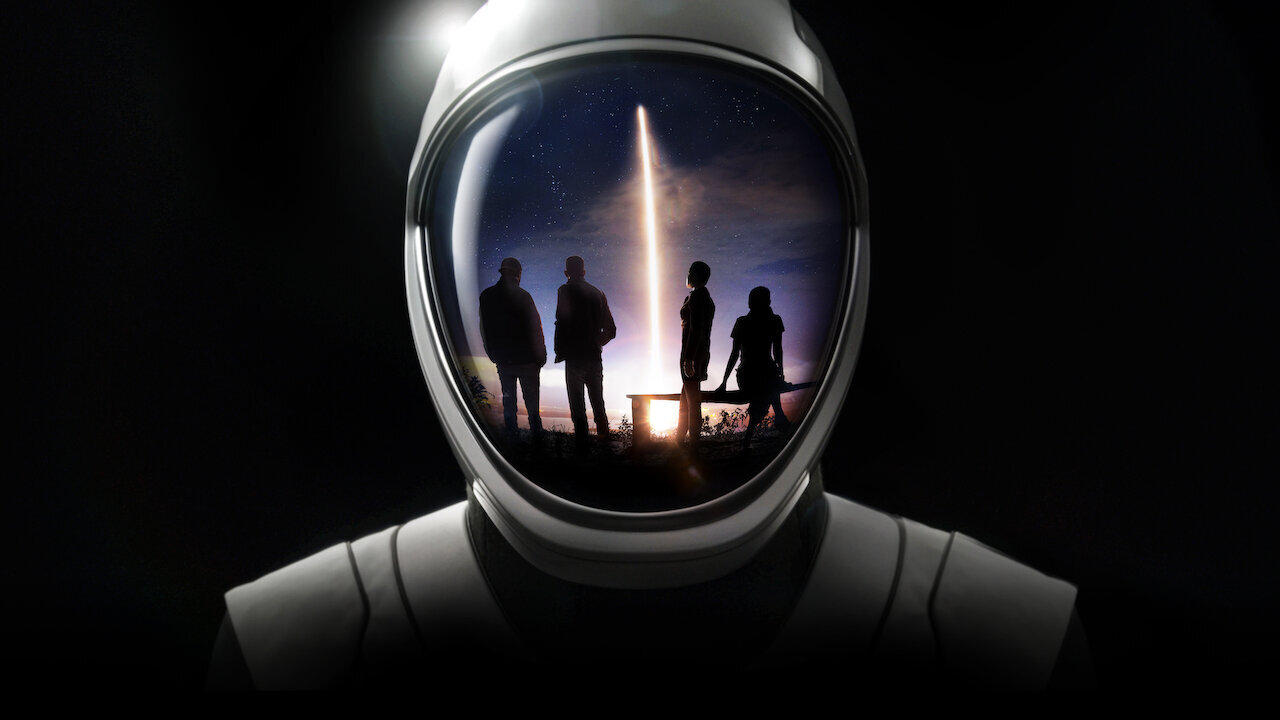
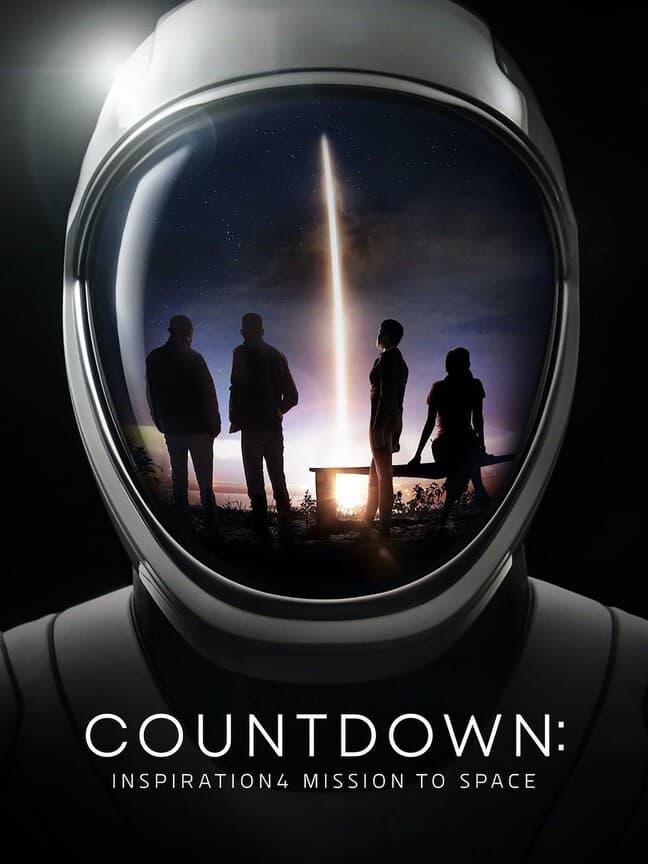

"This September, we're all going to space."
From training to launch to landing, this all-access docuseries rides along with the Inspiration4 crew on the first all-civilian orbital space mission.

Stream
Social & External
Self
Being an astronaut is the most dangerous and extraordinary job there is. But what's life really like in microgravity? This March, Channel 4 will boldly go to space with a groundbreaking new season, Live from Space. We'll meet the astronauts on-board the International Space Station, visit NASA and see Earth from Space.
On May 25, 1961, President John F. Kennedy made a historic speech where he pledged to send astronauts to the moon before the end of the decade. Eight years later, on July 20, 1969, Apollo commander Neil Armstrong stepped out of the lunar module and made a giant leap for mankind - a step that symbolized one of the most remarkable feats in human history. From that moment on, the exploration of our universe has achieved unimaginable feats with hundreds of missions stretching light years into the distant galaxy. This exciting documentary series takes viewers into the past, present and future of NASA.
A new "treasure map" of the Maya world is transforming what we thought we knew of one of the world most mysterious ancient civilizations.
Dive into the mysteries of some of NASA’s most curious missions and explore stories of engineering achievement and human endurance. Each episode offers first hand testimony from astronauts, NASA mission footage, plus beautifully rendered CGI to bring to life these voyages that reveal unexplained sightings that have dogged many of NASA’s most famous missions.
From the planets to the stars and out to the edge of the unknown, history and science collide in a wondrous yet deadly adventure through space and time.
This BBC series offers a fresh look at an amazing organization and mankind's quest to understand the universe. Blending stunningly restored footage with revealing, insightful and engaging interviews with the people who were there - the astronauts, family members and journalists - this is an epic story of the heroes, the triumphs and the tragedies of space exploration. Starting with NASA's beginnings in the Cold War, the series follows the iconic moments of space exploration from the race to get the first man in space to the first steps on the moon. And with triumph and achievement comes risk and disaster, as the series follows the white-knuckle suspense of Apollo 13 and the tragedy of the shuttle Challenger. Intelligent, inspiring and accessible, The Space Age is a complete history of mankind's journey into space.
A series of short stories about human space exploration.
For the 50th anniversary of the Apollo 11 mission, two immersive documentaries gave viewers the chance to re-live this awe-inspiring event as it unfolds in real time, with incredible cinematic NASA footage and global news archive. Episode One relives the drama of the launch, while Episode Two focuses on the landing, as the world followed the nail-biting moments leading up to the first ever boot print of Man on the Moon.
Inside NASA's Innovations takes you behind the scenes with one of the world's leading technology innovators. Find out what it takes to collaborate with NASA in developing the next breakthrough in space exploration.
The naturalist visits uncharted territory in pursuit of new discoveries. Steve Backshall takes on physical challenges, encounters extraordinary wildlife and meets remarkable people.
A miniseries documenting American human spaceflight, spanning from the first Mercury flights through the Gemini program to the Apollo moon landings, the Space Shuttle, and the construction of the International Space Station. It was created in association with NASA to commemorate the agency's fiftieth anniversary in 2008.
A users' guide to the cosmos, from the Big Bang to galaxies, stars, planets and moons: where did it all come from and how does it all fit together? A primer for anyone who has ever looked up at the night sky and wondered.
Glittering facades, vibrant life, and people facing the daily struggle for survival. ZDF correspondents each profile a megacity within their reporting area. How do people celebrate, laugh, and love in such a city? How are problems like housing shortages, food supply, transportation, and climate change solved – in metropolises with over ten million inhabitants?
National Geographic explorers have the best jobs ever! Find out what it's like to explore black holes, climb mountains, and go deep-sea diving for a living.
The inside stories of how the unknown engineers of NASA created such superior machines as the Saturn V moon rocket, the Space Shuttle, and the Hubble Space Telescope, often against incredible odds.
Engineers, officials and the crew members' families provide their perspective on the 1986 Space Shuttle Challenger disaster and its aftermath.
Lewis & Clark: The Journey of the Corps of Discovery tells the remarkable story of the entire Corps of Discovery – not just of the two Captains, but the young army men, French-Canadian boatmen, Clark’s African-American slave, and the Shoshone woman named Sacajawea, who brought along her infant son. As important to the story as these many characters, however, was the spectacular land itself, and the promises it held.
In 2003, Space Shuttle Columbia breaks apart in the skies above America. The astronauts’ families and Nasa staff share personal stories of the launch, unfolding disaster and fallout.
Infographics and archival footage deliver bite-size history lessons on scientific breakthroughs, social movements and world-changing discoveries.
Horizon tells amazing science stories, unravels mysteries and reveals worlds you've never seen before.
The series heads to the very frontiers of space and science to produce the definitive television history of science fiction, told through its impact on cinema, television and literature, with the help of filmmakers, writers, actors, and graphic artists. Each episode will explore one of the enduring themes of science fiction: time travel; the exploration of space; robots and artificial intelligence; and aliens.
Biography is a documentary television series. It was originally a half-hour filmed series produced for CBS by David Wolper from 1961 to 1964 and hosted by Mike Wallace. The A&E Network later re-ran it and has produced new episodes since 1987. The older version featured historical figures such as Helen Keller and Mark Twain, or long-dead entertainment figures such as Will Rogers or John Barrymore. The A&E series has placed the emphasis on such people as Marilyn Monroe, Elvis Presley, Plácido Domingo, Freddie Mercury, Jacqueline Kennedy Onassis, Eric Clapton, Pope John Paul II, Gene Tierney, Selena, Diego Rivera, Mao Zedong and Queen Elizabeth II, and fictional characters like The Phantom, Superman, Hamlet, Betty Boop, and Santa Claus. The program ended up profiling enough figures that in 1999, A&E spun it off into an entire network, The Biography Channel.
Influential builders, dreamers and believers whose feats transformed the United States, a nation decaying from the inside after the Civil War, into the greatest economic and technological superpower the world had ever seen. The Men Who Built America is the story of a nation at the crossroads and of the people who catapulted it to prosperity.
Revisit the epic heroes, villains and moments from across the MCU in preparation for the stories still to come. Each dynamic segment feeds directly into the upcoming series — setting the stage for future events. This series weaves together the many threads that constitute the unparalleled Marvel Cinematic Universe.
Since it began in 1983, Frontline has been airing public-affairs documentaries that explore a wide scope of the complex human experience. Frontline's goal is to extend the impact of the documentary beyond its initial broadcast by serving as a catalyst for change.
An in-depth look at the history and pop cultural significance of horror films.
PBS' premier science series helps viewers of all ages explore the science behind the headlines. Along the way, NOVA demystifies science and technology, and highlights the people involved in scientific pursuits.
20/20 is an American television newsmagazine that has been broadcast on ABC since June 6, 1978. Created by ABC News executive Roone Arledge, the show was designed similarly to CBS's 60 Minutes but focuses more on human interest stories than international and political subjects. The program's name derives from the "20/20" measurement of visual acuity. The hour-long program has been a staple on Friday evenings for much of the time since it moved to that timeslot from Thursdays in September 1987, though special editions of the program occasionally air on other nights.
MegaStructures is a documentary television series appearing on the National Geographic Channel in the United States and the United Kingdom, Channel 5 in the United Kingdom, France 5 in France, and 7mate in Australia. Each episode is an educational look of varying depth into the construction, operation, and staffing of various structures or construction projects, but not ordinary construction products. Generally containing interviews with designers and project managers, it presents the problems of construction and the methodology or techniques used to overcome obstacles. In some cases this involved the development of new materials or products that are now in general use within the construction industry. MegaStructures focuses on constructions that are extreme; in the sense that they are the biggest, tallest, longest, or deepest in the world. Alternatively, a project may appear if it had an element of novelty or are a world first. This type of project is known as a Megaproject.
Consistently stunning documentaries transport viewers to far-flung locations ranging from the torrid African plains to the chilly splendours of icy Antarctica. The show's primary focus is on animals and ecosystems around the world. A comic book based on the show, meant to be used an as educational tool for kids, was briefly distributed to museums and schools at no cost in the mid-2000s.
A worldwide guided tour of the greatest movies ever made and the story of international cinema through the history of cinematic innovation.

Documentary series tracing mankind's exploration of our solar system.
Executive producer Jon Favreau invites the cast and crew of The Mandalorian to share an unprecedented look at the making of the series. Each chapter explores a different facet of the first live-action Star Wars television show through interviews, never-before-seen footage, and roundtable conversations hosted by Favreau himself.
This immersive series follows the world's most magnificent creatures, capturing never-before-seen moments from the heartwarming to the outrageous.
An Idiot Abroad is a British travel documentary television series broadcast on Sky1 and Science, as well as spin-off books published by Canongate Books, created by Ricky Gervais and Stephen Merchant and starring Karl Pilkington. The ongoing theme of both the television series and the books is that Pilkington has no interest in global travel, so Merchant and Gervais make him travel while they stay in the United Kingdom and monitor his progress.

Explore Marvel’s rich legacy of pioneering characters, creators and storytelling to reflect the world outside your window. Each documentary, helmed by a unique filmmaker, showcases the intersections of storytelling, pop culture, and fandom within the Marvel Universe.