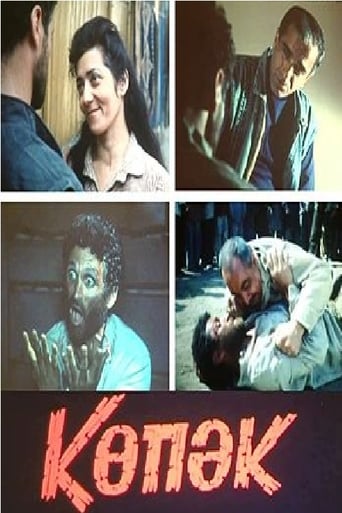
The film raises the problem of man's relationship to nature, the symbol of which is an old oak tree, protected by a forester from selfish people.
Social & External
Baghir
Nurjabbar
Nazli
Idrisov
Namaz
Sona
Leyli
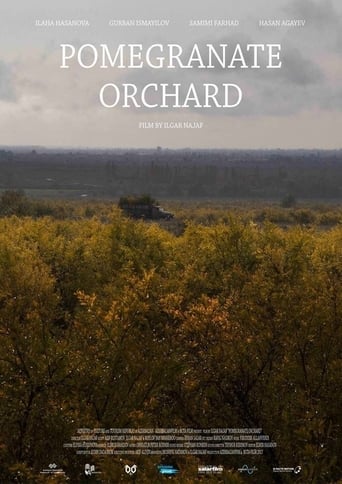
Inspired by Anton Chekhov's The Cherry Orchard, the film follows a prodigal son who returns after 12 years. His reappearance at the family home in rural Azerbaijan significantly alters their way of life.
A journalist is investigating a group of poachers who are illegally selling the huge amounts of fish
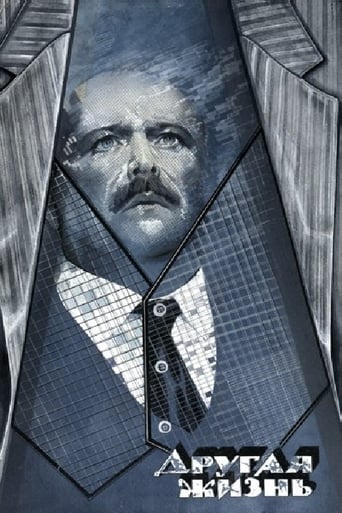
Film exposes the corruption and the decadence of the late Soviet bureaucracy in Azerbaijan SSR through the eyes of a naive Azerbaijani adult man, Hatem.
In a Azerbaijan, in the beginning of this century, the first films made in the history of cinema are shown.The characters meet each other in a room. Three characters who will witness the linking up of their destinies through their common love for this new captivating art.
War breaks out in the Caucasus. 75-year-old Maria loses her son in the war. She and her daughter-in-law Sofia have been living in the Caucasus for 12 years. When famine strikes, they want to move to Russia. The women decide that they must go to Moscow. Maria takes her little dog and Sofia her small suitcase, gets on the train and sets off. In the next compartment, photojournalist Alexander is also traveling. Sofia and Alexander love each other. Maria realizes at one of the stations near Volgograd that she cannot live without the Caucasus. She writes a letter to Sofia and leaves the train with her dog...
The story is set during an upsurge in the Nagorno-Karabakh conflict and revolves around an old, sick ex-forestry worker and his wife Nabat, whose son has died in battle.
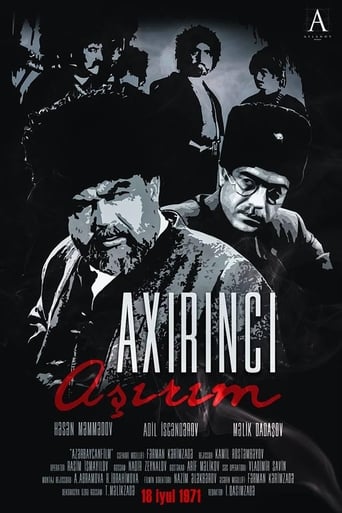
This film was based on Samad Vurgun's "Komsomol poem". Seven sons, like seven samurai become the seven komsomols (communist leaders) who were sent to a village to establish Soviet power. Seven sons become the romanticized images of people's heroes ready to take revenge.
While there is famine during WW2, a boy with mom far away, tries to stay strong.
During the late 1980s and early 1990s the Armenian minority in Nagorono-Karabakh attempted to break away from Azerbaijan, one of the former Soviet republics. Overnight these former neighbors became enemies, and simple village folk were suddenly made hostages in a complex power game. One of the Azerbaijani villages right on the border is home to the family of the peasant farmer Kerim, who has just been captured by the Armenians. The village council decides to take an Armenian in order to arrange a hostage exchange. They imprison the wounded man in the barn next to Kerim's house, where his wife and three children desperately await the husband's return. The captive from the other side of the border finds himself in exactly the same situation - he, too, has three children, he finds it hard to scrape a living together, he has never done anything to harm anyone and, like Kerim, he just wants to go back home. But life in Karabakh is far more complex now. Blood calls for blood.
Young Ruslan rows for a team coached by his father Ali, who places many demands upon his son and is continually dissatisfied by his performance. But when tragedy strikes, his father is overcome with emotions he doesn’t know how to deal with. Debut director Asif Rustamov treats the heavy topic with remarkable subtlety and discretion, emphasizing the characters’ carefully elaborated psychology.
The film is about commissary Chingiz Ildirim.
After the story of the same name of Rustam Ibrahimbeyov.
Murad, the favorite of the entire court, has just returned from prison, where he ultimately took the blame for his friend's crime. All this time, his fiancée Gul waited for him, and now they are getting married. Meanwhile, behind one of the doors overlooking Murad's garden, a woman's scream can be heard from time to time, but the neighbors do nothing. Will Murad be able to rise above the general indifference to his neighbor's affairs and help the unfortunate woman?
After the novel of the same name of M.Suleymanov. The film is about dramatic events between two workers.
After fulfilling his duty in Afghan War, Zaur returns to his home Baku. He is trying to clarify the truth when he heard that his father was arrested.
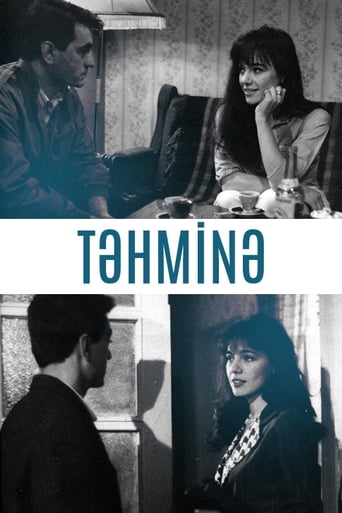
A young boy through a period of transition. His last baby tooth, which symbolises this period, is sore. He is scared of pulling it out, of saying goodbye to his dead mother and to his childhood. No one understands him, be is deprived from material physical affection. He himself does not understand his father who has brought another woman home. He feels this is an act of betrayal towards his dead mother.
The old shipyard repairman ust-Nazar returned to work after an illness. They were already preparing to see the old man off to retirement. But Ust-Nazar was able to convince his superiors of his efficiency, and they instructed him to repair the old boat. By spring, the boat was ready for sailing. When a huge ice floe threatened the oil rig during an ice break, the old man, without thinking about his own life, went with a battering ram to the ice block.
Azerbaijan in the 1930s. The difficult path to emancipation of Azerbaijani women, oppressed for centuries, who rebelled against the remnants of feudal customs, fanaticism, and fought for the right to be free citizens of their homeland.
About a young engineer's struggle for new, scientifically proven methods of working in drilling mines. His main opponent is a drilling foreman who prefers to be guided by his "sixth sense" in his work. In the end, engineer Geydar wins a double victory: he proves the superiority of new drilling methods over traditional ones and wins the heart of the old foreman's daughter. The film is considered banned.
On preserving moral principles and the importance of gaining the trust and respect of others.