How did the economy get started? Meet Ugg, Glugg and Tugg, three enterprising cave men who accidentally invented trade, marketing and the base elements of the modern market economy. The first film in the WE THE ECONOMY series.
Social & External
The film exposes the links between Agrifood and politics. With a pool of international experts it analyses the many problems related to factory farming: water pollution, migrants exploitation, biodiversity loss and antibiotic resistance.
Zeitgeist: Addendum premiered at the 5th Annual Artivist Film Festival. Director Peter Joseph stated: "The failure of our world to resolve the issues of war, poverty, and corruption, rests within a gross ignorance about what guides human behavior to begin with. It address the true source of the instability in our society, while offering the only fundamental, long-term solution."
A documentary examining possible historical and modern conspiracies surrounding Christianity, the 9/11 terrorist attacks, and the Federal Reserve bank.
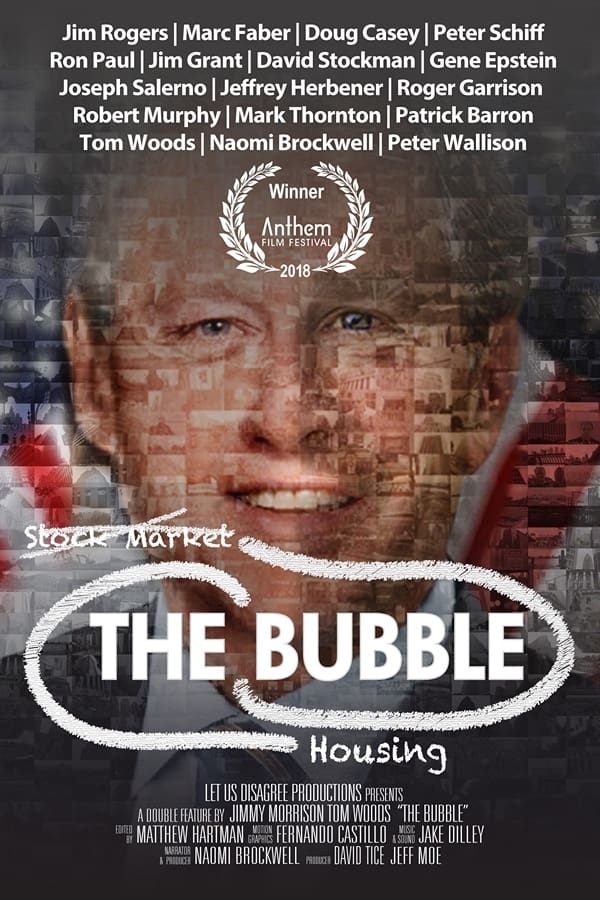
Diving deep into the true causes of the Great Recession, the financial crisis of the 2010s, renowned economists, investors and business leaders explain what America is facing if we don't learn from our past mistakes. Is the economy really improving or are we just blowing up another Bubble?
Overdraft is an award-winning film featuring leading thinkers and policymakers from across the aisle exploring major topics such as entitlement programs, defense spending, tax reform and the choices that America’s debt forces on individuals and businesses. Independently produced, Overdraft was launched in August 2012, and made available for broadcast on public television for two years through the National Educational Telecommunications Association (NETA).

A documentary about the development around Barton Springs in Austin, Texas, and nature's unexpected response to being threatened by human interference.
A fascinating compilation of scenes showing diversity and disparity in 1940s China. The ancient Forbidden City and Great Wall are followed by Shanghai’s metropolitan skyline; primitive farming methods are juxtaposed with mechanised factories; children in rags are contrasted with models wearing the latest fashions; Nationalist commanders and Communist leaders vie for support.
More and more fair trade labels are entering the market and are being positively received by consumers. In 2012, around five billion euros were spent on fair trade products. But is it really always fair where it says fair? Filmmaker Donatien Lemaître visited plantations in Mexico, the Dominican Republic and Kenya. The investigative documentary reveals how international corporations try to improve their image with the help of the fair trade concept - at the expense of small producers and their employees.
The Real Adam Smith: A Personal Exploration by Johan Norberg, takes an intriguing, two-part look at Smith and the evolution and relevance of his ideas today, both economic and ethical. It’s difficult to imagine that a man who lived with horse drawn carriages and sailing ships would foresee our massive 21st century global market exchange, much less the relationship between markets and morality. But Adam Smith was no ordinary 18th century figure. Considered the “father of modern economics,” Smith was first and foremost a moral philosopher. The revolutionary ideas he penned in The Wealth of Nations and The Theory of Moral Sentiments, changed the world. Norberg explores Smith’s insights regarding free trade and the nature of wealth to the present, where they are thriving and driving the world’s economy.
Ferdinand de Lesseps, known as “The Great Frenchman”, will embark in the greatest adventure of his life: To unite the Pacific and Atlantic oceans through a Canal in the Isthmus of Panama – without knowing that this will cost him his reputation, thousands of innocent lives and the biggest financial scandal of all time, up to that point: the famous “Scandal of Panama”. Today, the French capital is known as “Paname”.
Mobile homes have long been an affordable option for people who struggle with the cost of other housing in the United States. But now the economy of mobile home parks is under threat as private equity firms are buying up properties and looking to squeeze more money out of mobile home owners. Filmmaker Sara Terry uses this backdrop to explore urgent class issues that resonate across America, and especially in the high-priced rental market of New York City.
An unsettling and eye-opening Wall Street horror story about Chinese companies, the American stock market, and the opportunistic greed behind the biggest heist you've never heard of.
A historical perspective to understand Neoliberalism and to understand why this ideology today so profoundly influences the choices of our governments and our lives.
Humanity’s ascent is often measured by the speed of progress. But what if progress is actually spiraling us downwards, towards collapse? Ronald Wright, whose best-seller, “A Short History Of Progress” inspired “Surviving Progress”, shows how past civilizations were destroyed by “progress traps”—alluring technologies and belief systems that serve immediate needs, but ransom the future. As pressure on the world’s resources accelerates and financial elites bankrupt nations, can our globally-entwined civilization escape a final, catastrophic progress trap? With potent images and illuminating insights from thinkers who have probed our genes, our brains, and our social behaviour, this requiem to progress-as-usual also poses a challenge: to prove that making apes smarter isn’t an evolutionary dead-end.
Documentary about the modern apocalypse caused by a rapacious banking system. 23 leading thinkers – frustrated at the failure of their respective disciplines – break their silence to explain how the world really works.
In this documentary mosaic of a continued social disintegration, seven filmmakers bring to the screen protagonists and stories that live in an abyss of despair, in the chasm between those who have and those who do not. An old man rummaging for food in bins; a father who cannot give water to his infant daughter because he’s been cut off; an overcrowded ER that cannot cope under the pressure; a man who nearly buys an expensive Lexus and may yet decide to buy a Mercedes; a realtor in a well-fenced villa; and a mother sitting in a small crowded house with a hungry baby in one arm and a canister of gas in the other.
Detroit’s story has encapsulated the iconic narrative of America over the last century – the Great Migration of African Americans escaping Jim Crow; the rise of manufacturing and the middle class; the love affair with automobiles; the flowering of the American dream; and now… the collapse of the economy and the fading American mythos.
Set in 20th Century Japan the documentary explores the role and power of Central Banks and how they can be used to change a country's economic political and social structures A documentary adaption off the book by Professor Richard Werner.