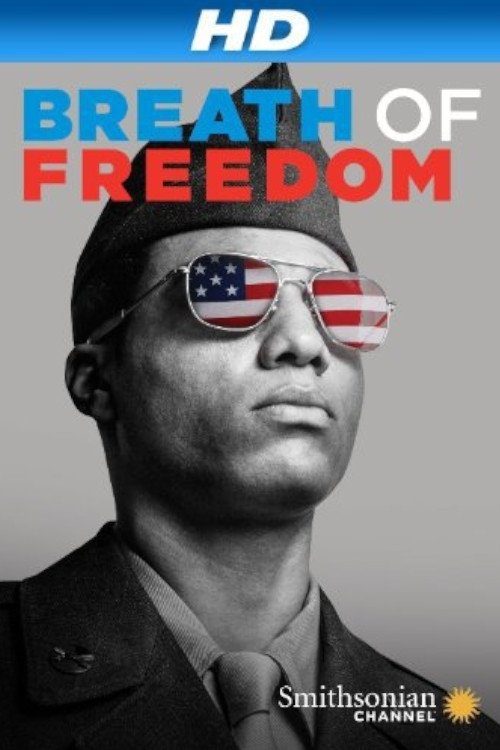
In World War II. African-American GIs liberate Germany from Nazi rule while racism prevailed in their own army and home country. Returning home they continue fighting for their own rights in the civil rights movement.

Social & External
Himself
These are strange times indeed. While they continue to command so much attention in the mainstream media, the 'battles' between old and new modes of distribution, between the pirate and the institution of copyright, seem to many of us already lost and won. We know who the victors are. Why then say any more?
Steal This Film focuses on Pirate Bay founders Gottfrid Svartholm, Fredrik Neij and Peter Sunde, prominent members of the Swedish filesharing community. The makers claimed that 'Old Media' documentary crews couldn't understand the internet culture that filesharers took part in, and that they saw peer-to-peer organization as a threat to their livelihoods. Because of that, they were determined to accurately represent the filesharing community from within. Notably, Steal This Film was released and distributed, free of charge, through the same filesharing networks that the film documents.
Narrated by actress Alfre Woodard, this trenchant, eye-opening doc traces the radical civil rights leader’s life from his tumultuous childhood, through his rise in the ranks of the Nation of Islam, to his 1965 assassination.
The story of the unjust incarceration of Japanese Americans and the loss of civil rights.
A short film entitled "A Letter To Claudette Colvin", written and directed by Victoria Wilson bringing awareness to Colvin's involvement in the Montgomery Bus Boycott which ignited due to her refusal on March 2, 1955.
The documentary film follows the life and career of Milen Tsvetkov against the backdrop of historical events in Bulgaria that have transformed journalism and the media market in the country since 1989.
The Black middle class, torn between white goals and Black needs, are examined by producers William Greaves and William Branch in a 90-minute NET Journal documentary.
The order comes in the summer of 1941 from propaganda minister Joseph Goebbels himself: The best animators are summoned to Berlin. Their task: Producing feature-length cartoons in ‘Disney-Quality’ with the newly founded ‘Deutsche Zeichenfilm GmbH’. To get trained, the Disney movie “Snow White” is re-traced frame by frame. After the final victory, one new feature-length production of quality shall be released every year from 1947 onwards. – that is the plan. Only in 1943, the first production is completed: “Armer Hansi” a 17-minute-long colour movie, realized with the effortful Multiplane-technology. The second film by the ‘Deutsche Zeichenfilm’ is only completed in 1946 – by DEFA. In the territories occupied by Germany, cartoons are produced as well, sometimes harmless ones, sometimes propagandistic ones. With excerpts from animated movies, life-action film documents, and witness reports by contemporaries, this documentary draws a picture of the cartoon production in the third Reich.
How could a German Wehrmacht soldier become a celebrated soccer idol of the Britons in the post-war period? The documentary by Radio Bremen shows the moving life story of the soccer star of the 1950s in a torn Europe and how an enemy became a friend. With his legendary appearance in the English Cup Final 1956, in which he played until the end despite a broken neck, Bert Trautmann set up a memorial for himself in the history of sport. Already in the same year, he is chosen as England’s footballer of the year, and by his club Manchester City even as best player of all times. Bernhard “Bert” Trautmann is one of the most popular and best-known soccer players in England.


Uli Köhler and Nick Golücke have visited the protagonists of the 1990 World Cup 20 years after their championship win and looked back together. The Writers Nick Golücke and Uli Köhler have, 20 years after World Cup triumph of the German national soccer team in Rome in 1990, visited the protagonists of back then once again and indulge with them together in memories.
The AfD, founded in 2013, is a right-wing party that has become increasingly radicalized in recent years. To illustrate this, only those who enthusiastically joined the party in its early years are heard. They describe what they looked for and found in the party, but also how and why they left, disillusioned and frightened by the AfD's developments. How did they experience the party's radicalization process? How did friends and family react? When and why did they decide to turn their back on the party? How difficult was the exit process? The documentary provides an illuminating inside view of this party, which has been driving the established parties and the political establishment ahead of it for over ten years, gives viewers a unique look into the AfD's chronicle and world of thought and is at the same time a film about the mechanisms of political radicalization.
Documentary about filmmakers of the New German Cinema who were members of the legendary Filmverlag für Autoren (Film Publishing House for Authors). Among them are Werner Herzog, Rainer Werner Fassbinder, and Wim Wenders.
In 1885, German Zoo owner Carl Hagenbeck hired nine Aboriginal men from Bella Coola to perform their dances and songs for German audiences. The nine dancers spent one year in Germany performing in zoos and theatres in 22 cities. During summer 2005, the Canadian filmmaker Barbara Hager came to Germany to retrace the steps of the nine Nuxalk men on their original 13 month long tour.
A documentary following the day life of fans in Brazil on July 13, 2014: the day when Germany and Argentina met up in the finals of FIFA World Cup.
Starting as a documentary on the sexually liberated culture of late-Sixties Denmark, Sexual Freedom in Denmark winds up incorporating major elements of the marriage manual form and even manages to squeeze in a montage of beaver loops and erotic art. All narrated with earnest pronouncements concerning the social and psychological benefits of sexual liberation, the movie, is a kind of mondo film dotted with occasional glimpses of actual sex.
Christof Wackernagel, best known in Germany as an actor and former member of the Red Army Faction ("RAF") lives in Mali. In his compelling portrait, Jonas Grosch shows a man who simply cannot stand still if he senses injustice. The courage to stand up for one’s beliefs coupled with vanity? However one chooses to look at it, it is easy to imagine what made him connect with the "RAF". With his irrepressible will for freedom, Christof Wackernagel gets entangled in the horrors of day-to-day life in Africa.
The ruin pub phenomenon in Budapest jolted the city to life like an explosion in the early 2000s. The capital, which had flourished and buzzed with culture at the turn of the century, was levelled in an instant by the Second World War. The people living here had to start from scratch, and through perseverance and determination, the city once again began to thrive—only to slide toward decline once more. Budapest exists within this cycle, and the ruin pub is part of it, encapsulating a sense of permanence built from the ruins of Eastern Europe.
The youngest protagonist of the documentary is Wartburg, an automobile over 50 years of age. The car is still on the road, driven by Bogdan, a 70-year-old who is taking his mother to visit the German factory where she was forced to work during WWII. In this road movie which takes place between Majdanpek and Germany, the trip becomes a journey into the past, retracing memories from the war and revealing a unique relationship between an old son and his elderly mother.
French documentary campaigning for the liberalization of abortion and contraception, directed by Charles Belmont and Marielle Issartel in 1973.
The remarkable spirit of tap dancers and their history provides a joyous backdrop for intimate portraits of hoofers Sandman Sims, Chuck Green, and Bunny Briggs.