Social & External
An investigation by Professor of Geological Sciences, Roger Bilham, of the science behind the earthquake and tsunami off the coast of Japan on March 11, 2011.
February 2010. On a remote island in the Pacific Ocean called Juan Fernández, everyone slept in town. But a 12-year-old girl felt a tremor and warned of imminent danger.
A minute-by-minute account of the Boxing Day 2004 Tsunami told through amateur video footage of people who were there.
Starting off a kilometre high, travelling at the speed of a jet aircraft, and heading for us. It doesn't make for a good outcome. Hollywood-style graphics and real-life archive bring home an imagined near-future scenario, all based on cutting-edge science. —Trevor
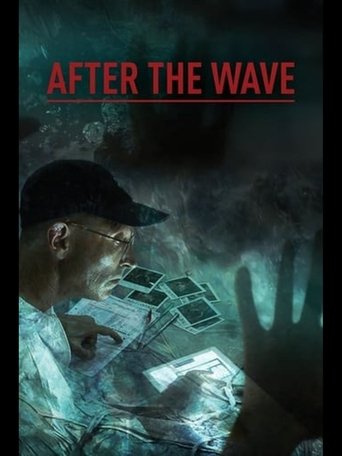
The Boxing Day Tsunami in 2004 was the most devastating natural disaster in modern times, killing 228,000 people across 13 countries in just a few hours. AFTER THE WAVE tells the untold story of this epic forensic operation in Thailand to identify and return home the bodies of over 5,000 victims, both locals and holidaymakers from around the world. Led by a crack Australian team, the best forensic specialists from around the world were in a race against time to give back every victim their identity. Creating forensic history, the international team’s mantra from the outset was ‘we will take them home’, a seemingly impossible ambition but one that almost succeeded. In this film forensic science intersects with powerful stories of survival and loss, attempting to make some sense out of a tragedy so bewilderingly complete that nearly a decade out it still seems far-fetched to most of us.
Acclaimed Australian journalist Ray Martin and remarkable Australians return to the epicentre of the tragedy, uncovering incredible stories of hope and resilience.
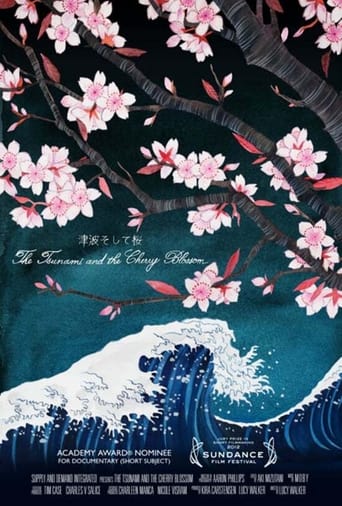
On 11 March 2011, an earthquake caused a tsunami to hit the Tōhoku (Northeast) region of Japan. In this film, survivors of the tsunami rebuild as cherry blossom season begins. The film is a stunning visual haiku about the ephemeral nature of life–and of the healing power of Japan's most beloved flower.
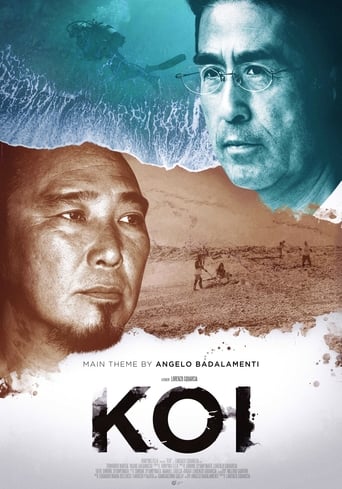
There's no definitive separation as long as there is memory'. Since the Tsunami hit the northern part of Japan's coast in 2011, more than 20 thousand people lost their lives, and many others are still missing. As time went by the families of the victims abandoned all hope and stopped looking for their loved ones. However, this is the story of two men that are still fully committed to their respective searching activities. Even though their backgrounds are extremely different, both share a strong force of will and firmly wish to keep alive the memories of the ones that went missing. Perseverance is what pushed an ex-convict to look for redemption by helping the victims' families to find the remains of their loved ones, and perseverance is what brought a bus driver to start to dive in order to search for his wife.
On March 11, 2011, Okawa Elementary School in Ishinomaki City was engulfed by a tsunami, and 74 children, or 70% of the school's children, were killed. 51 minutes elapsed between the earthquake and when the tsunami reached the school. The school was informed of the tsunami and a school bus was on standby, but students did not evacuate. Okawa Elementary was the only school that suffered a large number of casualties in this earthquake. This documentary follows the lawsuit that followed the disaster, where the parents sought the truth behind the tragedy.
It was one of the greatest natural disasters of all time. On the morning of Boxing Day 2004, a massive tsunami hit the coast of the Indian Ocean. More than 230,000 people died, including many holidaymakers from Germany and France. On the occasion of the 20th anniversary, survivors tell their stories. How has the disaster affected their lives to this day?
Re-examines the dramatic events of Boxing Day 2004, and investigates the new science of Tsunami forecasting.
On March 11 2011, after a magnitude 9 earthquake, a giant tsunami destroyed most of the north eastern japanese coast, killing almost 20,000 people.
The globe learned on December 26, 2004, that tsunamis can bring death and devastation to the world's coastlines. The product of undersea earthquakes and volcanic eruptions, tsunamis can race across oceans at more than 500 miles an hour, leaving a huge wake of destruction when they hit shore. Because it is difficult for scientists to predict how large these massive waves can be, tsunamis are one of the least understood of nature's forces, and one of the most dangerous. With insight from some of the scientific community's foremost researchers, and vivid accounts from past tsunami survivors, Tsunami: Killer Wave depicts nature at its most extreme, profiles the efforts being made to curb its effects, and illustrates the financial, physical and emotional toll it can leave on its victims.
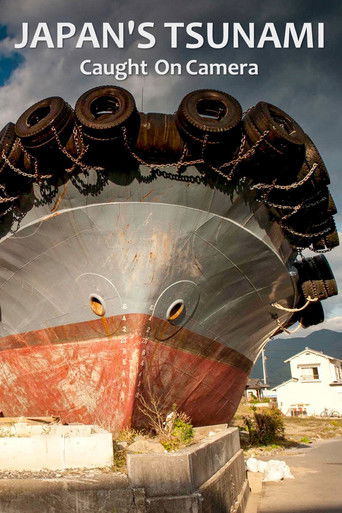
Eyewitness accounts of the tsunami that devastated Japan in March 2011, captured by the people who kept filming as the cataclysmic events unfolded around them.
The story of the March 2011 Great East Japan Earthquake and tsunami as told through news footage and eyewitness video footage.
The story of a camera that perished in a Tsunami. The Film shares special moments that the Filmmaker experienced with his camera, a special bonding over a period of four years, creating cinematic imagery, relating, exploring, seeking and interpreting notions of his reality. It is a memory of a camera which perished in the tsunami, along with its last filmed footage – elusive images, evoking multiple possibilities, seeking parallels and new perspectives.
Ten years after one of the most deadly tsunamis ever known, scientists are making a shocking discovery. Experts used to believe that the biggest killer waves were only generated in a handful of regions, but mounting evidence now suggests that more of the world’s coasts, from the Mediterranean to Australia, could be in grave danger. But where will the next Big One strike?
A documentary that explores the downloading revolution; the kids that created it, the bands and the businesses that were affected by it, and its impact on the world at large.
Alexander McQueen's rags-to-riches story is a modern-day fairy tale, laced with the gothic. Mirroring the savage beauty, boldness and vivacity of his design, this documentary is an intimate revelation of McQueen's own world, both tortured and inspired, which celebrates a radical and mesmerizing genius of profound influence.
Alex Gibney explores the charged issue of pedophilia in the Catholic Church, following a trail from the first known protest against clerical sexual abuse in the United States and all way to the Vatican.
A visual montage portrait of our contemporary world dominated by globalized technology and violence.
The story of life on our planet by the man who has seen more of the natural world than any other. In more than 90 years, Attenborough has visited every continent on the globe, exploring the wild places of our planet and documenting the living world in all its variety and wonder. Addressing the biggest challenges facing life on our planet, the film offers a powerful message of hope for future generations.
JB Smoove and Martin Starr host a celebration of 20 years of "Spider-Man" movies, from the Sam Raimi trilogy to Marc Webb's movies and the trio from Jon Watts.
A documentary focused on plastic pollution in the world's oceans.
A look at the state of the global environment including visionary and practical solutions for restoring the planet's ecosystems. Featuring ongoing dialogues of experts from all over the world, including former Soviet Prime Minister Mikhail Gorbachev, renowned scientist Stephen Hawking, former head of the CIA R. James Woolse
A documentary on the expletive's origin, why it offends some people so deeply, and what can be gained from its use.
The Making-of James Cameron's Avatar. It shows interesting parts of the work on the set.
A documentary on Al Gore's campaign to make the issue of global warming a recognized problem worldwide.
Alex Gibney explores the phenomenon of Stuxnet, a self-replicating computer virus discovered in 2010 by international IT experts. Evidently commissioned by the US and Israeli governments, this malware was designed to specifically sabotage Iran’s nuclear programme. However, the complex computer worm ended up not only infecting its intended target but also spreading uncontrollably.
Artists in LA discover the work of forgotten Polish sculptor Stanislav Szukalski, a mad genius whose true story unfolds chapter by astounding chapter.
David Attenborough takes viewers on a breathtaking journey showing there is nowhere more vital for our survival, more full of life, wonder, or surprise, than the ocean. Through spectacular sequences featuring coral reefs, kelp forests and the open ocean, Attenborough shares why a healthy ocean keeps the entire planet stable and flourishing.
A chronicle of the life, work and mind that created the Cthulhu mythos.
Interviews with leading authors, philosophers and scientists, with an in-depth discussion of the Law of Attraction. The audience is shown how they can learn and use 'The Secret' in their everyday lives.
A documentary about the making of David Fincher's 2008 film THE CURIOUS CASE OF BENJAMIN BUTTON. Virtually every element in the evolution of the Fincher's film is documented here, from the project's attachment to numerous other directors during the 1990s, to its shoot in 2006 and 2007 in New Orleans, to its complex, CGI-intensive postproduction process.
A non-narrated documentary following the lovesome lives of four infants from birth to their first birthday. The babies featured are two from rural areas: Ponijao from Opuwo, Namibia, and Bayar from Bayanchandmani, Mongolia, as well as two from urban areas: Mari from Tokyo, Japan, and Hattie from San Francisco, USA.
A look at the origins, history and conspiracies behind the "Majestic 12", a clandestine group of military and corporate figureheads charged with reverse-engineering extraterrestrial technology.
The life and career of an actor, artist, and icon. His own journey through his own camera.