"Freeride lines of Patagonia"
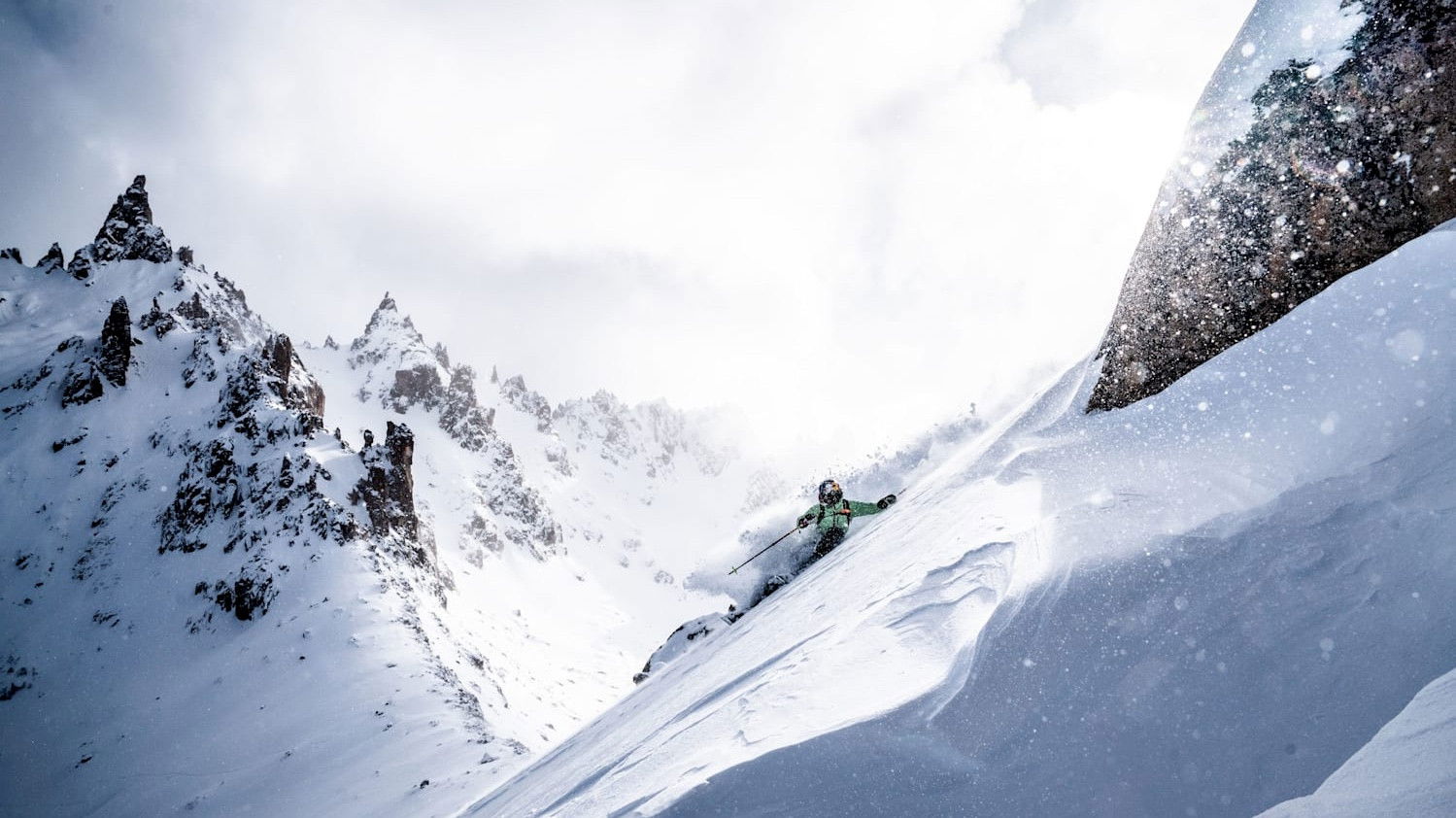
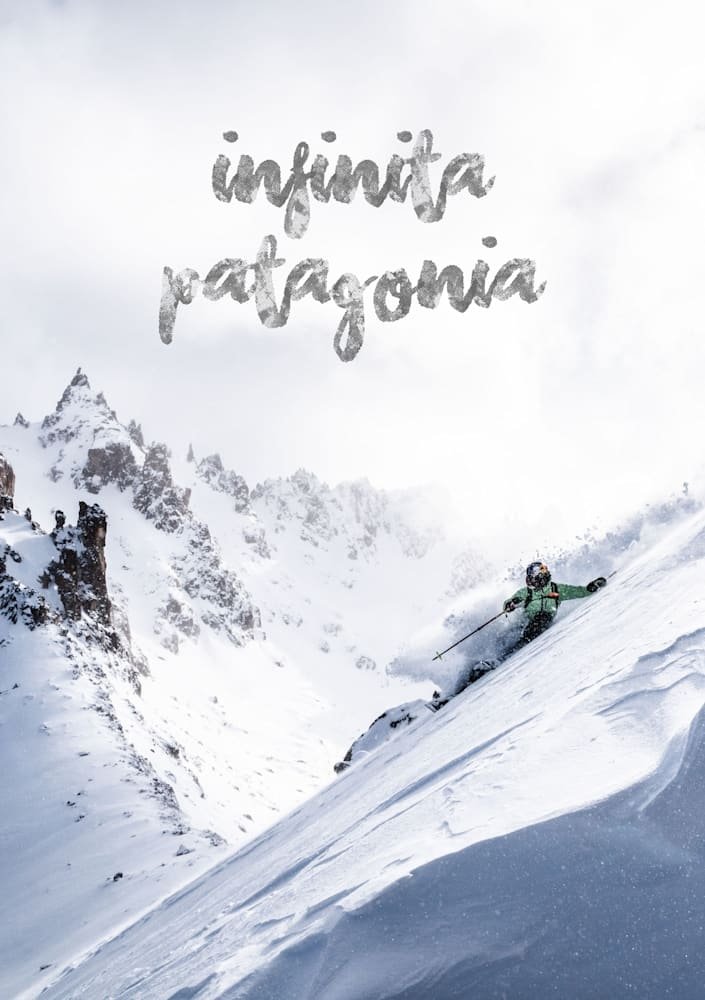
Nadine Wallner journeys to El Chaltén, Argentina, a place of granite towers, perfect for skiing adventures. Infinita describes its endless beauty and here she found her passion and tranquillity.
Social & External
Self
From humble beginnings, complex family dynamics and tragic, life-changing events, to her unlikely rise to success in two very different worlds: fashion modeling and professional skiing. “How Did I Get Here” is a coming-of-age story, full of adventure, exploration, heartbreak, growth and inspiration.
The film reconstructs the mysterious story of the 1942 Patagonia World Soccer championship, never acknowledged by the official sports organizations, and which for decades have remained shrouded in legend without the winner ever being known.
Sam Anthamatten (ski) and Victor de Le Rue (snowboard) push new boundaries in the wildest corner of Alaska. A bush pilot drops the small crew of five on a remote, unexplored glacier to conquer the spine walls in a series of ascents, each one more committed. Narrator Jérôme Tanon describes with honesty and a touch of sarcasm what exactly is going on here. Above all, he wants to feel what it’s like to be in their shoes, to understand what so called “free riders” are made of, and what could be the purpose and beauty of “freeriding”.


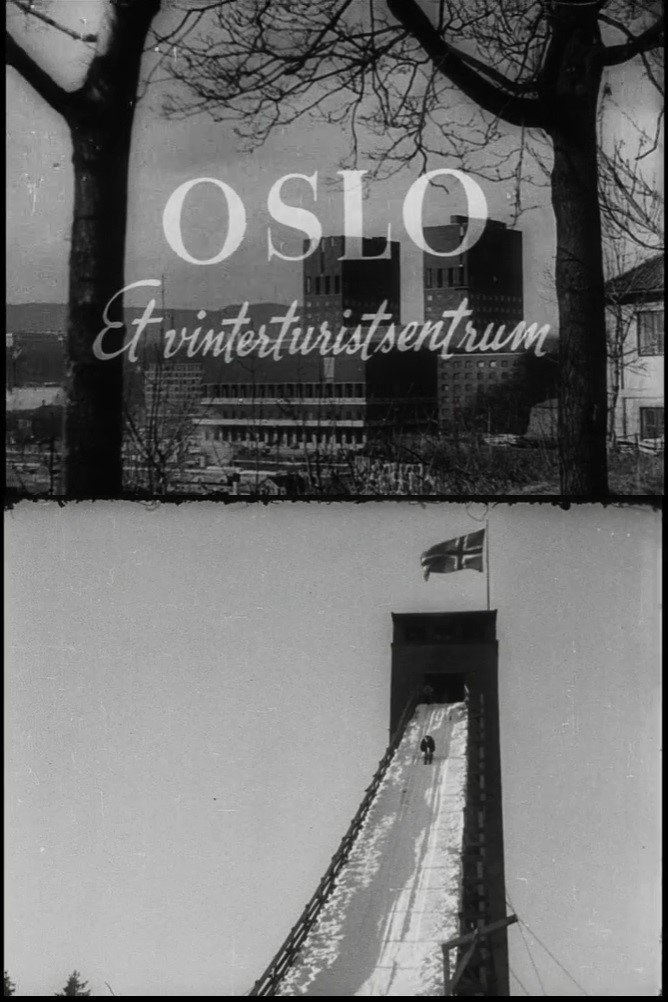
This Pete Smith Sports Champion short visits Southern California where it quickly moves from orange orchards to the mountain snow playground at Big Pines L.A. County Camp for some winter sports including sledding, skating, and ski jumping.
From the mind of Chris Benchetler comes TGR's latest short film collaboration. Improvisation is the silver thread that weaves this crew together. Just as the Grateful Dead did not fit their music into an established category, this short film finds a cast of some of the world’s best athletes on a spontaneous journey of skiing, snowboarding, surfing, and music, complete with a soundtrack comprised of only Grateful Dead music.
For 27 years, Teton Gravity Research has been searching for the right place with the right crew at the perfect time to experience life at its fullest. Between the thrill of the hunt and the peace of floating down a mountain, the sum of our experiences becoming greater than its parts is what we seek. If you ask us, our annual snow film Magic Hour is just that.
After years of preparation, a team of highly motivated Quebeckers set out on one of the longest wilderness expeditions ever documented. Stage one involves skiing in relentless polar conditions from Ellesmere Island to the Northwest Passage where the challenge was reaching the mainland. Cue canoes for a 2000km journey across Nunavut and NWT until they reach the first dirt road available where bikes are waiting to be pedalled 4000km to Point Pelee in Ontario.
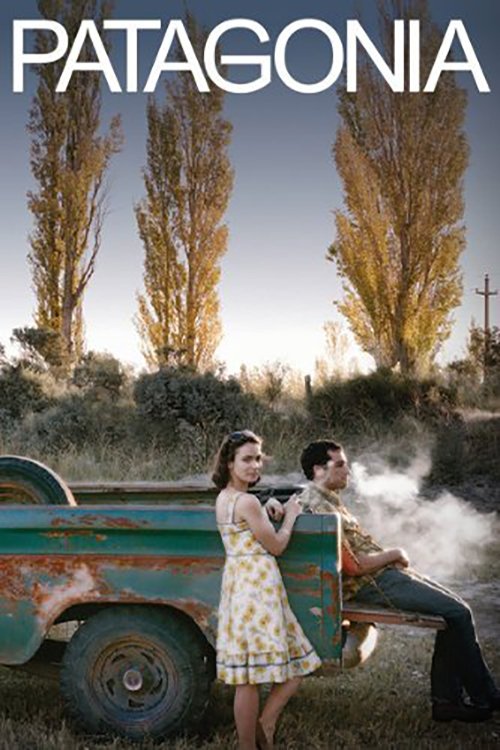
Patagonia narrates the journeys of two women - one looking for her past, the other for her future. The film inter-cuts between their stories, in which one of them travels south to north through the Welsh springtime and the other east to west through the Argentine autumn.
Östlund discovered his penchant for long takes making ski films, in which unbroken shots prove the authenticity of the unbelievable feats depicted. Stunning compositions and an energetic soundtrack (featuring Swedish hip-hop, electronica, ska, and thrash metal) make this a sensory delight, even for those who aren’t skiing enthusiasts.
Snow dancing and spectacular skiing stunts are showcased in this lively video program hosted by star skiers Suzy Chaffee and John Eaves. The antics are backed by the music of Alan Parsons, Harold Faltermaier, Gary Wright and John Denver. Much of the footage comes from the ski film Fire and Ice.
While filming an advertisement, some extreme sports enthusiasts unwittingly stop a group of terrorists.
Film about the 10th Olympic Games in Grenoble in 1968. Using a subjective camera, Ertaud and Languepin take the pulse of the Games, cutting out the eyes and slowing down the movement when necessary. The dominant figure at the Grenoble Winter Games is Frenchman Jean-Claude Killy, whose three gold medals matched Toni Sailer's 1956 feat. The filmmakers bet on his winning streak, and include commentary from him as he prepares for each race. Another athlete, Marielle Goitschel, is treated insightfully on screen and wins the women's slalom. Ice dancing fans will appreciate the coverage of winner Oleg Protopopov and his partner Ludmila Belousova. President Charles De Gaulle was present for the spectacular Opening Ceremony.
Esperanto is TGR’s latest action-packed mountain bike film with an added twist. Mixing the rock stars of the sport with a cast of unknown and up-and-coming heroes, the film explores how we share our dreams through a universal two-wheeled language no matter what our native tongue may be. The sacred ritual of the ride might sound different all across the world – whether it’s a full-face getting pulled down to drop into a big jump line or wheeling a beat-up bike out of a mud hut to pedal to school – but it’s a universal process no matter what language we speak. There are more than 7000 languages spoken on Earth. In 1887 a Polish-Jewish doctor named L.L. Zamenhof created a new one, a universal second language based on a combination of existing widely-spoken European languages. Its goal, to help bring people together from different ideologies, beliefs, and nations and ultimately to help end war. The language was called Esperanto. Translated into English it means ‘one who hopes.’
Directed by Jean-Marc Boivin in 1977, Glace Extrême is a documentary about mountaineering and extreme skiing at the Aiguille Verte and the Grand Pilier D'angle in the Mont-Blanc massif chain in France, with the legends of mountaineering Jean-Marc Boivin, Patrick Gabarrou and ski champion Patrick Vallencant. It was broadcast in the Carnet de L'Aventure on France 2 in 1980.
Marc-André Leclerc, an exceptional climber, has made solo his religion and ice his homeland. When filmmaker Peter Mortimer begins his film, he places his camera at the base of a British Columbia cliff and waits patiently for the star climber to come down to answer his questions. Marc André, a little uncomfortable, prefers to return to the depths of the forest where he lives in a tent with his girlfriend Brette Harrington. In the heart of winter, Peter films vertiginous solos on fragile ice. He tries to make appointments with the climber who is never there and does not seem really concerned by this camera pointed at him "For me, it would not be a solo if there was someone else" . Marc-André is thus, the "pure light" of the mountaineers of his time, which marvel Barry Blanchard, Alex Honnold or Reinhold Messner, interviewed in the film. An event film for an extraordinary character.
Escape from Patagonia is a gaucho-western film set in the tumultuous Patagonia of late nineteenth century. It's a story of survival, based on real facts from the personal diary of the Argentinian pioneer Francisco P. Moreno.
Paragot and Bérardini: two climbers who fill all climbing enthusiasts with admiration. In Fontainebleau, Saussois, the Alps, the Andes, the Himalayas, and all over the world, they have left their names attached to the most difficult routes and the most prestigious peaks. Here, they recount only the climbs they completed together: famous expeditions to Aconcagua and Huascarán, firsts in the Alps and the Dolomites. An unwavering friendship, comical and tragic adventures—this is what they share with us in the warm atmosphere of their memories. "La Cordée des Voyous" will be included in Jean Afanassieff's film "La Grande Cordée," which deals with post-war proletarian mountaineering.
A mechanic discovers the fossil of a huge carnivorous dinosaur, unleashing a war between scientists, mayors and neighboring towns to keep “the biggest dinosaur in the world.” Among bone thefts, replicas and a mayor obsessed with creating Dinolandia, anything goes when it comes to surviving.
A small, elite fraternity of high-altitude skiers climb the highest peaks in the world in pure Alpine style, carrying their skis and declining to use supplemental oxygen. At the top of the world, high in the Death Zone, they lock into their skis and challenge the most dangerous slopes in the world—under weather conditions that are as perilous as the thin air, hidden crevasses and 10,000 ft. sheer faces that drop into Nepal and Tibet far below.