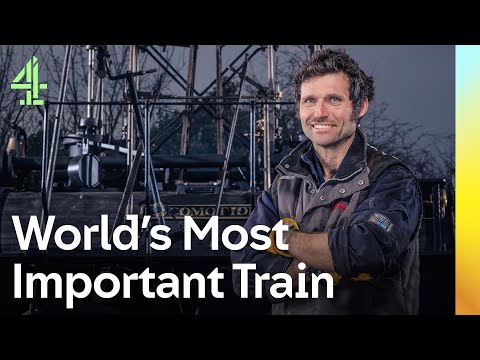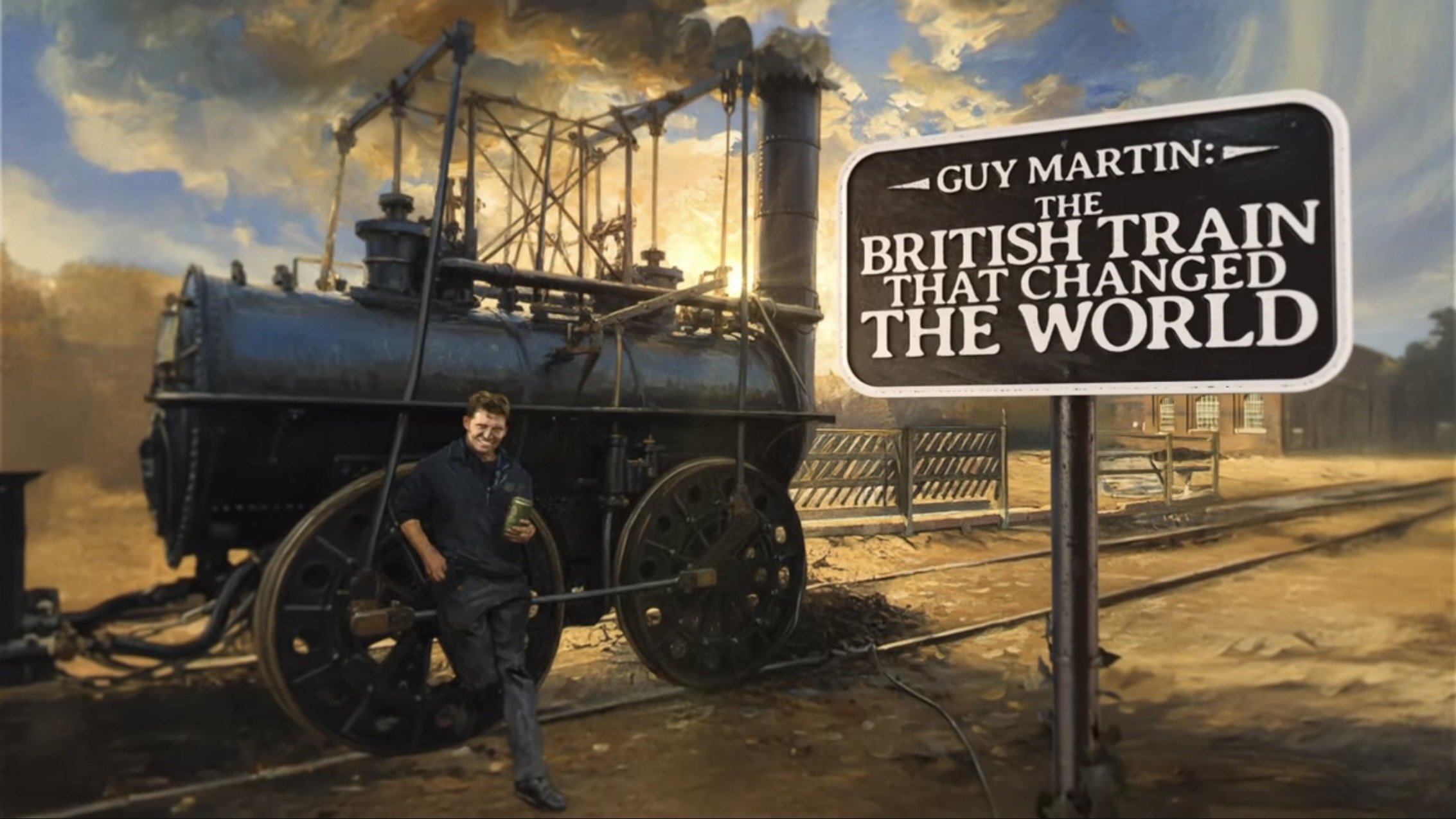
Celebrating 200 years of rail, Guy helps to rebuild, and learns to drive, the world’s most important train for a recreation of the journey that changed history: the Stockton to Darlington Railway
Social & External
Self
Self - Narrator (voice)
Take a breathtaking train a ride through Nothern Quebec and Labrador on Canada’s first First Nations-owned railway. Come for the celebration of the power of independence, the crucial importance of aboriginal owned businesses and stay for the beauty of the northern landscape.
The story of how newspapers were distributed during the Blitz, stressing the importance of an accurate and objective press on the home front.
A short documentary about the construction of the parisian subway in the 50s.
Canadian Pacific I is made up of a series of slowly dissolved shots done from the same framing over several months. The camera frames a window with a railway yard in the foreground, a bay in the space behind it, and misty mountains in the extreme distance. Trains occasionally pass by in the foreground. Huge ships move across the bay. Blue mists hover over the mountain heads.
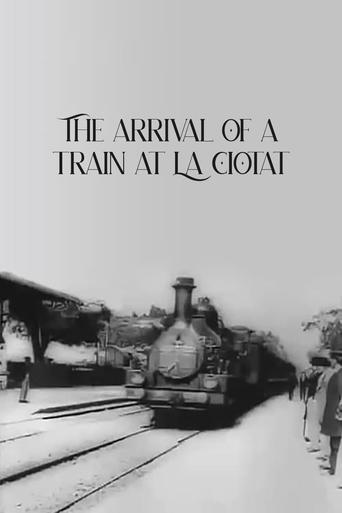
A group of people are standing along the platform of a railway station in La Ciotat, waiting for a train. One is seen coming, at some distance, and eventually stops at the platform. Doors of the railway-cars open and attendants help passengers off and on. Popular legend has it that, when this film was shown, the first-night audience fled the café in terror, fearing being run over by the "approaching" train. This legend has since been identified as promotional embellishment, though there is evidence to suggest that people were astounded at the capabilities of the Lumières' cinématographe.
A day in the city of Berlin, which experienced an industrial boom in the 1920s, and still provides an insight into the living and working conditions at that time. Germany had just recovered a little from the worst consequences of the First World War, the great economic crisis was still a few years away and Hitler was not yet an issue at the time.
The Channel Tunnel linking Britain with France is one of the seven wonders of the modern world but what did it take to build the longest undersea tunnel ever constructed? We hear from the men and women, who built this engineering marvel. Massive tunnel boring machines gnawed their way through rock and chalk, digging not one tunnel but three; two rail tunnels and a service tunnel. This was a project that would be privately financed; not a penny of public money would be spent on the tunnel. Business would have to put up all the money and take all the risks. This was also a project that was blighted by flood, fire, tragic loss of life and financial bust ups. Today, it stands as an engineering triumph and a testament to what can be achieved when two nations, Britain and France put aside their historic differences and work together.
Railman is a film concerned as much with the distribution of roles within the film collective as with getting “as close as possible to the life and routines” of an NUR station master. Filmed at Grove Park Station, Lewisham, in south east London, and set against the backdrop of state divestment in transport infrastructure, Railman might be regarded as a modest and experimental corrective to officially sanctioned British Transport Films.
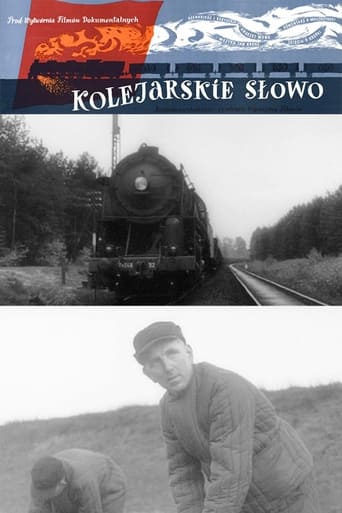
A film about winter railroading in the Canadian Rockies and the men who keep the lines clear. The stretch between Revelstoke and Field, British Columbia, is a snow-choked threat to communications. The film shows the work of section hands, maintenance men, train crews and telegraph operators.
"The End of the Line - Rochester's Subway" tells the little-known story of the rail line that operated in a former section of the Erie Canal from 1927 until its abandonment in 1956. Produced in 1994 by filmmakers Fredrick Armstrong and James P. Harte, the forty-five minute documentary recounts the tale of an American city's bumpy ride through the Twentieth Century, from the perspective of a little engine that could, but didn't. The film has since been rereleased (2005) and now contains the main feature with special portions that were added as part of the rereleased version. These include a look at the only surviving subway car from the lines and a Phantom tun through the tunnels in their abandoned state, among others, for a total of 90 minutes of unique and well preserved historical information.
A puffing steam train climbs into the Himalaya, a rolling rumble echoes over the holy waters of the Ganges, an astonishing five million commuters rush daily through the Bombay Victoria Terminus - join National Geographic as we journey on one of the world's largest railways. Since 1853, India's railway has been a unifying force. Not only did it physically link distant regions, it also connected the myriad of castes, languages, and religions that comprise India. It's a rich history, riding the sumptuous Palace on Wheels through Rajasthan or the "toy train" to Darjiing, but sadly, the age of steam is dying. At the Black Beauty contest, the beloved steam engines are admired for the last time. From the driver in the steaming locomotive to the station master in the sleepy village, from the family traveling to a wedding to the commuters in the large cities, this great institution reflects the country itself. Many are the faces, and varied are the stories, on THE GREAT INDIAN RAILWAY.
This short documentary shows the reactions of European immigrants as they land in Halifax at the beginning of the 1960s. From the port, we follow them on a snowy journey by train to Montreal.
On a train crossing Tanzania, a rolling microcosm of East African society, we follow three main characters, reflecting on the strength to survive.
Part-fiction documentary into the New Silk Road. AAA Cargo traces the anticipation of infrastructure and trade on a planetary scale, following its distribution networks which are expanding across vast regions between China and Europe. Here, government efforts to speed up the movement of trade collide with more-than-human choreographies of sand, people and goods.
Trace the history of Hitler's armored private train, a 15-car mobile headquarters boasting state-of-the-art communications and anti-aircraft cannons.
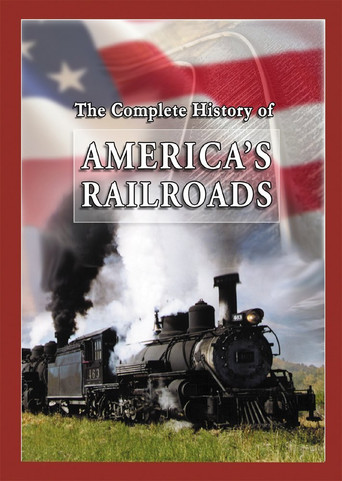
When the first railroads were built some two hundred years ago, they brought about a revolutionary change for mankind, linking cities and countryside, driving the industrial revolution and irrevocably changing the landscape: a history of the railroad from its beginnings to the present day.
A family embarks on an annual tormenting journey along with 130 million other peasant workers to reunite with their distant family, and to revive their love and dignity as China soars as the world's next super power.
A Union Pacific production outlining the Big Boy locomotive and the history of the last great steam engine to rule the rails