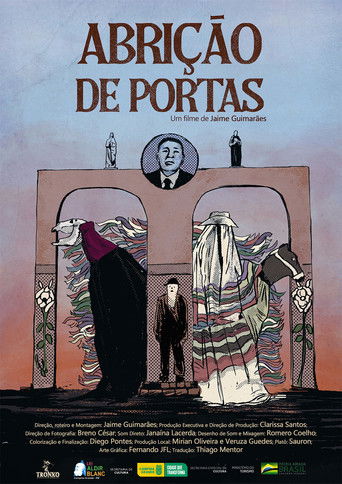
In 1928, the city of Curitiba went through a rare snowstorm. To this day, it is the harshest snowstorm to ever take place in the city. Everything was recorded by Alberto Botelho in this short documentary.
Social & External
Working men and women leave through the main gate of the Lumière factory in Lyon, France. Filmed on 22 March 1895, it is often referred to as the first real motion picture ever made, although Louis Le Prince's 1888 Roundhay Garden Scene pre-dated it by seven years. Three separate versions of this film exist, which differ from one another in numerous ways. The first version features a carriage drawn by one horse, while in the second version the carriage is drawn by two horses, and there is no carriage at all in the third version. The clothing style is also different between the three versions, demonstrating the different seasons in which each was filmed. This film was made in the 35 mm format with an aspect ratio of 1.33:1, and at a speed of 16 frames per second. At that rate, the 17 meters of film length provided a duration of 46 seconds, holding a total of 800 frames.
Every year, thousands of Antarctica's emperor penguins make an astonishing journey to breed their young. They walk, marching day and night in single file 70 miles into the darkest, driest and coldest continent on Earth. This amazing, true-life tale is touched with humour and alive with thrills. Breathtaking photography captures the transcendent beauty and staggering drama of devoted parent penguins who, in the fierce polar winter, take turns guarding their egg and trekking to the ocean in search of food. Predators hunt them, storms lash them. But the safety of their adorable chicks makes it all worthwhile. So follow the leader... to adventure!!
What do Daniel Webster, Dr. Seuss, C. Everett Koop, Robert Frost and 100+ Winter Olympians have in common? They all spent time at Dartmouth College, Hanover, NH where winters are long and snowy. Passion for Snow traces over 100 years of ski history in the United States with a focus on the many contributions of Dartmouth College and its alumni to the formation, growth and ongoing innovations in all aspects of snowsports. Passion for Snow combines firsthand accounts from early ski pioneers, veterans of the 10th Mountain Division, Olympians, members of the U.S. Ski Hall of Fame and top ski industry and resort executives, who explain how the most remotely located college in the Ivy League helped spawn a $25 billion industry, and continues to shape it today.
In southern Germany, winter can still be admired in all its glory every year. With its white coat of snow and icicles and myriads of small crystals that look like geometric works of art. In the valleys and on the slopes the snow is still so thick every year that the alpine huts are snowed in up to the windows. Cows and dairymen are safe in their farms at lower altitudes. But not the wild creatures of the mountains! They need strategies to survive the cold season and to defy snow masses, cold and ice. And some seem to do it so easily that they even raise their young in the middle of winter. But how do animals, plants and fungi cope with the annually recurring ice age, which from our perspective is a time of need? The many adaptations in nature prove that winter is an integral part of the natural cycle of the year and the living environment of species. They are adapted to cold and frost. That is why the animals and plants at the edge of the Alps suffer particularly from climate change!
Atlantis is filmmaker Luc Besson's celebration of the beauty and wonder of the world beneath the sea, expanding upon themes touched on in his film The Big Blue. Combining stunning underwater cinematography and a hypnotic score by Eric Serra, Besson's singular vision defies dialogue or narrative structure to explore ocean life as you've never seen it before. Following the colossal success of The Big Blue, Luc Besson crisscrossed the world's seas and oceans to film the beauty and diversity of marine life: from the giant octopuses of Vancouver to the manta rays of the Pacific (New Caledonia), and the grey sharks of Tahiti. A film with no actors or sets other than the underwater world. A breathtaking view of marine species: sharks, dolphins, manatees, octopuses. An exploration of the seabed in the Bahamas, the Galapagos, Vancouver, and Tahiti.
A journey through the Brazilian Amazon, guided by the eyes of Renato, a Carioca turned Amazorioca. A reflection on identity, the legacy of an ancestral territory, and the cost of progress. An ode to the forest and the fragility of what remains.
Standard Films spanned the globe this past winter documenting the best snowboarding in the greatest mountain ranges to catch the vapors. Witness pro snowboarders descend huge mountain peaks, drop endless pillows lines, boost off huge backcountry kickers, hit unique urban features and destroy custom resort parks. Catch the Vapors is the progression of All Terrain, Freestyle, All Mountain and Backcountry Snowboarding!
Once again Absinthe Films raises the bar to bring you 'More'. This title marks the beginning of a new era for Absinthe Films as they have broadened their scope to include and properly represent urban riding while still keeping the overall blend fresh and un-repetitive.
Takes us to locations all around the US and shows us the heavy toll that modern technology is having on humans and the earth. The visual tone poem contains neither dialogue nor a vocalized narration: its tone is set by the juxtaposition of images and the exceptional music by Philip Glass.
Four siblings, whose father disappeared during Brazilian Military Dictatorship, report their childhood during the regime.
Telescopic chronophotography of the 1882 transit of Venus as observed from Lick Observatory.
With searing insight that shines light in dark corners, EATING OUR WAY TO EXTINCTION is a compelling feature documentary that opens the lid on the elephant in the room no one wants to talk about. Confronting and entertaining, this documentary allows audiences to question their everyday choices, industry leaders and governments. Featuring a wealth of world-renowned contributors including Sir Richard Branson and Tony Robbins, it has a message of hope that will empower audiences.
Battle of Portland Harbor was a Civil War that took place in 1863. This is a independent student-made documentary about it.
Wisconsin's tribe's ongoing fight to protect Lake Superior for future generations. "Bad River" shows the Bad River Band of Lake Superior Chippewa's long history of activism and resistance in the context of continuing legal battles with Enbridge Energy over its Line 5 oil pipeline. The Line 5 pipeline has been operating on 12 miles of the Bad River Band's land with expired easements for more than a decade. The Band and the Canadian company have been locked in a legal battle over the pipeline since 2019.
A documentary on Al Gore's campaign to make the issue of global warming a recognized problem worldwide.
Following the Prophet Muhammad’s (PBUH) recommendation to journey to three mosques - (in Makkah, Madinah and Jerusalem), this film sets out in the company of British bass player Danny ‘Hamza’ Thompson to discover the reasons why the last of these three holds such an important place in the hearts of Muslims everywhere.
Neurobiology has shown in the recent years that contrary to the traditional boundaries between animal and plants, plants can feel, move and even think. Over the recent years, a small but growing group of researchers from Austria, Germany, Italy, UK, Japan, South Africa and the USA, has developed a new scientific field of research: the neurobiology of plants. Their discoveries question the traditional boundaries set between the animal and the vegetable kingdom: plants are capable to develop the cognitive process claimed by humans and animals. If plants can move, and feel... Could they possibly think ? In a creative and captivating scientific investigation style, through spectacular specialist photography and CGI, and re-creating scientific experiments, this documentary is bound to change your own perception of plants.