“From This” is a permanent cycle. This video intended to be timeless in its original action plan, to be played constantly in a particular place, with a TV, a player and a power generator.
Social & External
IDFA and Canadian filmmaker Peter Wintonick had a close relationship for decades. He was a hard worker and often far from home, visiting festivals around the world. In 2013, he died after a short illness. His daughter Mira was left behind with a whole lot of questions, and a box full of videotapes that Wintonick shot for his Utopia project. She resolved to investigate what sort of film he envisaged, and to complete it for him.
Today, analogue video is attractive primarily thanks to the distinctive aesthetic quality of its pixelated image and raster errors. But for Czech artists who first explored the possibilities offered by video art in the late 1980s, this medium represented a path towards freedom. Through a portrait of her grandfather Radek Pilař, one of the pioneers of Czech video art, the director explores her own legacy of imperative creative fascination. Her film’s main story, i.e., the process of reconstructing the 1989 exhibition Video Day, contrasts this enchantment with life in the final days of the totalitarian regime, which different sharply with the adventures of those who decided to emigrate – whom the filmmaker also visits in order to discover forgotten works, get to know their creators, and re-establish broken ties.
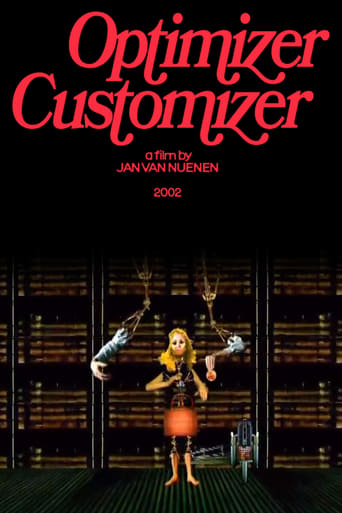
A feminine machine, stuffed with modern nano-technology and useless operations is depicted in this mixed-media 2D animation short, highlighting the consequences of consumerism and the downfall of civilized society. The machine reminiscent of a two-dimensional video game, leads to a destructive chain reaction after a strange malfunction, with people turning into clones and robots.
While you wait to hear if they'll pay your claim, there is almost nothing like the silent buzz at the other end of the line. Or when you say something that requires a response and the world says back, "no worries". There's an art to miscommunication, unthinking, the void, and the customer service call. Phoning it in might just be a necessary part of life. This rough-edged sketch mixing performance art living and film is a study of the phone call, American doofiness, and blank minds under the reign of the corporate call script. Everyone is impotent in the institutional setting.
A collection of 8mm film reels from İlhan Mimaroğlu’s archive—once tucked away in whisky boxes—has found new life through art. Curated by director Serdar Kökçeoğlu and producer Dilek Aydın, the project brings together visual artists and musicians to reimagine these long-lost images. Over thirty artists transformed the footage into fifteen distinct audiovisual pieces, blending experimental soundscapes with contemporary video art. The project concludes with a special highlight: the first-ever screening of Mimaroğlu’s silent short film about a street jazz festival, accompanied by Erdem Helvacıoğlu’s dark jazz score.
A fiction science monologue about artificial fertilization and its consequences, delivered by four characters interacting with the text.
An attic, a giant sewing needle and an anti-gravity fairy tale of sibling rivalry. Three sisters fight over who gets the biggest phallus in this post-feminist animation-infused playground by media artist Michelle Handelman. If Hans Christian Anderson got a sex change, surfed the porn sites, and hung with the freaky girls, his stories would look like this.
Video art piece by Michigan artist Gio Orlando.
data-verse is a data-driven audio-visual trilogy by artist and composer Ryoji Ikeda which marks a two-decade culmination in the artist’s research. The trilogy addresses the layered dimensions of our world, from the microscopic, to the human, to the macroscopic. Through Ikeda’s process, massive scientific data sets have been transcribed, converted, transformed, de/re/meta-constructed and orchestrated to visualise and sonify the different dimensions that co-exist in our world between the visible and the invisible. Each variation immerses visitors in the vast data universe in which we live, capturing hidden facets of nature and the vast scientific knowledge underpinning our existence. This large-scale data-driven trilogy is generated by extremely precise computer programming and features a minimalist electronic soundtrack, harmonised with Hollywood-standard, high-definition, 4K DCI video projections of scientific data onto a large screen.
Four Poems is a series of video poems in which the horizontal lines of a poem, usually composed of text, have been substituted for horizontal lines of moving image. The piece explores what remains of a poem when its language is removed, and how images might interact with each other in similar or different ways to words. It asks whether rhyme, rhythm, sibilance, or dissonance, might be effectively created by juxtaposing images. It also asks whether arranging images might create a sense of authorship, intentionality, or a tone of voice, in the way that arranging words might. Finally, Four Poems invites the viewer to consider how they might ‘read’ a poem – does a reading have to occur from top-to-bottom, or might new interpretations be possible when the moving parts of the poem can all be seen at once?
One of Paik’s most overtly political and poignant statements, Guadalcanal Requiem is a performance/documentary collage that confronts history, time, cultural memory and mythology on the site of one of World War II’s most devastating battles.
Paik produced this exuberant, high-speed collage as a commission for the National Fine Arts Committee of the 1980 Olympic Winter Games. In a fractured explosion of densely layered movement and action, images of Olympic sports events are mixed with Paik’s recurring visual and audio motifs.
In Junior War, a throng of highschoolers congregate at night for a party in the woods sometime in the year 2000. A band plays, the kids get drunk, the boys and girls tepidly flirt, and groups deploy into cars for the purpose of destroying mailboxes, tee-peeing houses, breaking lawn ornaments, and sparring with the police. The film is composed entirely of footage Trecartin took during his senior year of high school in exurban Ohio; as such, it baits the viewer with genealogical significance.
Arbitrary Logic, an interactive audio-visual synthesiser was first presented under the working title Osnabruk at the Osnabruk festival of 1987 and later as part of an improvised and computer music performance with Keith Rowe at the London Filmmakers Cooperative, December 1989.
Ted Hughes's 1993 novel The Iron Woman is the springboard for this multi-media project by Mikhail Karikis. The video section of the installation features seven-year-olds from Mayflower Primary School in East London discussing the novel's environmental themes.
Part one of the two part abstract video art-piece, with music composed by Philip Glass and performed by the Kronos String Quartet.
Someone wanders through a house while fleeing from a mysterious presence. Their body dissolves on-screen, and their mind is invaded by a strident gray noise.