Social & External
Why did the Roman Empire, which dominated Europe and the Mediterranean for five centuries, inexorably weaken until it disappeared? Archaeologists, specialists in ancient pathologies and climate historians are now accumulating clues converging on the same factors: a powerful cooling and pandemics. A disease, whose symptoms described by the Greek physician Galen are reminiscent of those of smallpox, struck Rome in 167, soon devastating its army. At the same time, a sudden climatic disorder that was underway as far as Eurasia caused agricultural yields to plummet and led to the westward migration of the Huns. Plagued by economic and military difficulties, attacked from all sides by barbarian tribes, the Roman edifice gradually cracked.
Pouvoir Oublier is a political documentary first constructed from the words of the speakers whose lives changed on the tragic day of May 10, 1972 in Sept-Îles. Their word will be juxtaposed with archival material from the events, some of which are unpublished, which will reflect the collective euphoria in which Sept-Îles and all of Quebec were then bathed.
As clichés go, in 1999 the World as we knew it was about to change - and we'd been expecting it. Since childhood we'd been promised that the 21st century would bring us dramatic new technologies like flying cars and Utopian cities. Instead it bought us the smart-phone, social media, and virtual societies. And as it turns out these technologies began to transform society almost as dramatically as the moon colonies we'd been expecting. Now over a decade into the revolution, 'DSKNECTD' explores how digital communication technology is profoundly changing the way we interact and experience each other - for the good and for the bad.
About Stefan Stricker, who calls himself Juwelia and has been running a gallery on Sanderstraße in Berlin Neukölln for many years. Every weekend he invites guests to shamelessly recount from his life and to sing poetic songs written with his friend from Hollywood Jose Promis. Juwelia has been poor and sexy all her life, has always struggled for recognition, but only partially.
The Philippines remains the only nation without legalized divorce. Through the perspectives of a controversial priest, a women's rights advocate, and a child of a separated couple, this documentary explores whether the legalization of divorce in the country would be for better or worse.
A short documentary about the construction of the parisian subway in the 50s.
The film explores the potential for automation in every sector of employment and questions the integrity of our methods of resource distribution going into the future.
Disobedience tells the David vs. Goliath tale of front line leaders battling for a livable world. Filmed in the Philippines, Turkey, Germany, Canada, Cambodia and the United States, it weaves together these riveting stories with insights from the most renowned voices on social justice and climate. Disobedience is personal, passionate and powerful - the stakes could not be higher, nor the mission more critical.
Pauline, Norah, Kristina and others wait for hours, sitting under a hut deep in the Bois de Vincennes. In front of the administrative detention center (CRA) in Paris, they have all come to see their loved ones locked up. Lives on hold, awaiting deportation or release. On this stage, these women tell their stories, talk to each other, share their experience, their revolt and their dreams with new visitors. They are the mirror of migrant detention, its reverse view.
Some 20 years ago, two sex workers were murdered in an upper-class Brussels neighborhood. Celebrated Belgian magistrate Anne Gurwez decides to revisit this cold case, pouring over the evidence with the use of new technologies and tracking down then-suspects.
In Quebec, the lakes we love and take for granted are quickly perishing, as highlighted by the proliferation of aquatic plants and algae in our water bodies. With images of lakes and dozens of interviews, the documentary points the finger at those responsible for this decline.
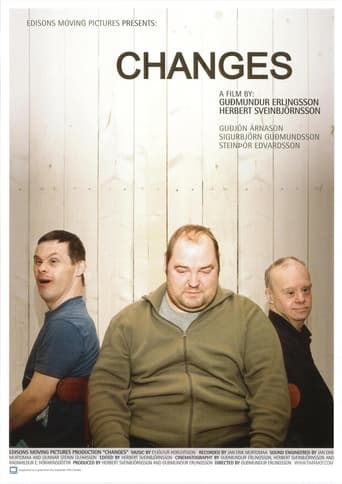
Tímamót, or Changes in English. An upbeat, heartwarming story about Gudjon, Sigurbjorn and Steinthor who lived together for decades along with several other inhabitants in the Tjaldanes Institution, in a peaceful valley close to Reykjavik. When a decision is made to close down the institution, their life takes an unexpected turn and they discover a new side to life and to themselves.
Approximately, because so-called "ethnic" statistics are prohibited, there are an estimated 3.3 million black French citizens. Distant descendants of slaves from the Caribbean or "indigenous" peoples from the French colonial empire in Africa, they constitute a minority that is often discriminated against. Isabelle Boni-Claverie, a mixed-race woman raised in the affluent neighborhoods of Paris, daughter of an Ivorian politician and granddaughter of Alphonse Boni, a Black man who became a magistrate of the French Republic in the 1930s, examines what is blocking the social advancement of Black French people and the full recognition of their citizenship.
Gilles Groulx's first film shot in 1955 with a camera borrowed from his brother and edited during his spare time when he worked as an editor at the Radio-Canada news service a few years before he joined the NFB. Silent film, presented as its author left it, where the soil and the dialectic of Groulx's work are already there: documentary realism, the social space to be explored, daily life, the relationship between individual and society, social disparities, the consumer society, seduction and happiness.
Since the enactment of the Anti-Boryokudan Act and Yakuza exclusion ordinances, the number of Yakuza members reduced to less than 60,000. In the past 3 years, about 20,000 members have left from Yakuza organizations. However, just numbers can’t tell you the reality. What are they thinking, how are they living now? The camera zooms in on the Yakuza world. Are there basic human rights for them?
The film does not have a plot per se; it mixes documentary footage, along with standard movie scenes, to give the audience the mood of Germany during the late 1970s. The movie covers the two-month time period during 1977 when a businessman was kidnapped and later murdered by the left-wing terrorists known as the RAF-Rote Armee Fraktion (Red Army Fraction). The businessman had been kidnapped in an effort to secure the release of the original leaders of the RAF, also known as the Baader-Meinhof gang. When the kidnapping effort and a plane hijacking effort failed, the three most prominent leaders of the RAF, Andreas Baader, Gudrun Ensslin, and Jan-Carl Raspe, all committed suicide in prison. It has become an article of faith within the left-wing community that these three were actually murdered by the state.
Shot during three seasons, Kenuajuak's documentary tenderly portrays village life and the elements that forge the character of his people: their history, the great open spaces and their unflagging humour. Though Kenuajuak appreciates the amenities of southern civilization that have made their way north, he remains attached to the traditional way of life and the land: its vast tundra, the sea teeming with Arctic char, the sky full of Canada geese. My Village in Nunavik is an unsentimental film by a young Inuk who is open to the outside world but clearly loves his village. With subtitles.