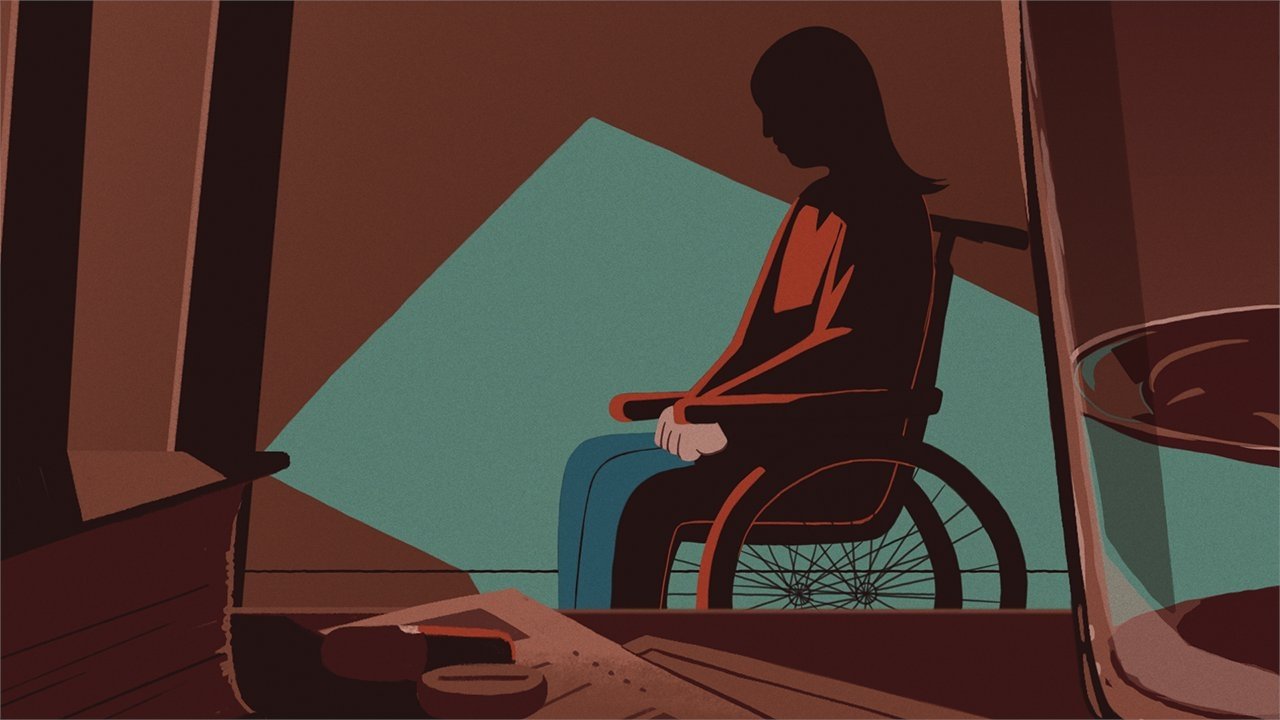
People with learning disabilities often experience worse physical and mental health. This film is a starting point to address these inequalities.
Social & External
Set to a classic Duke Ellington recording "Daybreak Express", this is a five-minute short of the soon-to-be-demolished Third Avenue elevated subway station in New York City.
In the future, technology may change, but the patterns and routines of daily life stay constant, until we disrupt them. A short animation by Matthias Hoegg.
A talented group of orphaned children in Swaziland create a fictional heroine and send her on a dangerous quest.
"Wolfe" is an intimate confessional from Nick, who learned through puberty that the imaginary friend in his head was real, and violent.
Set in Berlin and New York's Lower East Side, The Great Yiddish Love stars the self-exiled Marlene Dietrich and her Nazi-endorsed replacement, Zarah Leander. It is a melodrama of love, emigration, and betrayal reassembled from Hollywood, German Ufa and Yiddish films from the 1930s and 40s.
In her attempt to escape her past, Huiju relocated to the UK over 11 months ago. However, even after moving to a new country, she found that her nightmares from Korea continued to haunt her. Determined to move forward, she made the decision to confront her memories head-on in a very contemporary way, using dating apps to push the boundaries she had set due to her sexual trauma.
Documentary about the special friendship between the 72-year-old music machine collector Johann Bartisch and the 12-year-old farm boy Gerd from the village of Arnsgereuth. As a child, the Romanian Johann played "O sole mio" on the piano while his brother accompanied him on the violin. Even then, he was fascinated by the music machines that could be found at fairgrounds, in cinemas and on trains. As an adult, Johann began his passion for collecting in Bucharest, rescuing self-playing instruments from barns, cellars or even garbage dumps. With great attention to detail, Johann restores his found treasures in his 250-year-old schoolhouse in the village of Arnsgereuth.
Over the course of 10 months, a camera travels to Buenos Aires, Argentina and Hanover, Germany to meet with Magalí, María Belén, Ivana and Carla, the founding members of the Archivo De La Memoria Trans Argentina, the first existing Trans Archive in the world. Taking the shape of a photo-novel, the documentary not only recounts the founding members lives as trans women under the Argentine dictatorship (1976-1983), the AIDS epidemy, state repression and mass assassinations but also years of fighting for their rights, sorority and the exaltation of life and laughter in times of death. Filming each one of them is filming them embracing their new role as curators, archivists and historians while a collection of 7,000 photos goes through the filter of their memories.
Join a demon, a puppy and a rat in this stop-motion headtrip about a mysterious, magically summoned apple tree. With its innovative, intricate character design and intoxicatingly evocative, genuinely strange world, Oldboy’s Apples makes for tactile, ritualistic viewing – a rabbit hole of idolatry and the id.
A ruminative film on the interplay between bovine lives and human consumption. Minimalist in camerawork and composition yet expansive in impact, With the Cattle poignantly brings viewers up close and personal to the tranquillity – and ephemerality – of life for farm cows.
An "Ock-umentary" exploring the character of Doc Ock and the way he as well as his tentacles were brought to life on the silver screen.
When winter comes, it is hard for those who try to escape from the colds alone, relying only on themselves. The heroes of one of the most famous folk tales come to this conclusion. The tale became the literary basis of the film. The age-old folk wisdom is embodied here in a simple story.
Anti-nuclear cartoon about a soldier at a nuclear test site. Among other things, the mutating effect of radiation is shown in a bizarre form.
Merenguito, a little piñata boy, wakes up on a school table after being put together by a group of primary school children. Soon they discover his gift: dispensing candy at will. When the children become absorbed by their greed for candy, Merenguito finds comfort in his friendship with Bruno, a gentle child outcast from his peers due to his delicate health condition. Chaos soon erupts and Merenguito becomes a victim of merciless bullying that spirals him into a choice with terrible consequences.
In the midst of a publishing revolution, The Atlanta Journal-Constitution, one of America's most storied institutions of journalism, is experimenting with new tools to tell stories in preparation for the end of print in the digital era.
An exploration —manipulated and staged— of life in Las Hurdes, in the province of Cáceres, in Extremadura, Spain, as it was in 1932. Insalubrity, misery and lack of opportunities provoke the emigration of young people and the solitude of those who remain in the desolation of one of the poorest and least developed Spanish regions at that time.
This documentary is featured on the DVD for Captain Blood (1935), released in 2005.
In 1928, as the talkies threw the film industry and film language into turmoil, Chaplin decided that his Tramp character would not be heard. City Lights would not be a talking picture, but it would have a soundtrack. Chaplin personally composed a musical score and sound effects for the picture. With Peter Lord, the famous co-creator of Chicken Run and Wallace & Gromit, we see how Chaplin became the king of slapstick comedy and the superstar of the movies.
A young Polish partisan flees from the Warsaw Uprising. Whilst hiding in the yard of a countryside manor, he is chased up a tree by a large wolfhound. With his rifle out of reach, there seems to be no way to escape his predicament.
A group of people are standing along the platform of a railway station in La Ciotat, waiting for a train. One is seen coming, at some distance, and eventually stops at the platform. Doors of the railway-cars open and attendants help passengers off and on. Popular legend has it that, when this film was shown, the first-night audience fled the café in terror, fearing being run over by the "approaching" train. This legend has since been identified as promotional embellishment, though there is evidence to suggest that people were astounded at the capabilities of the Lumières' cinématographe.