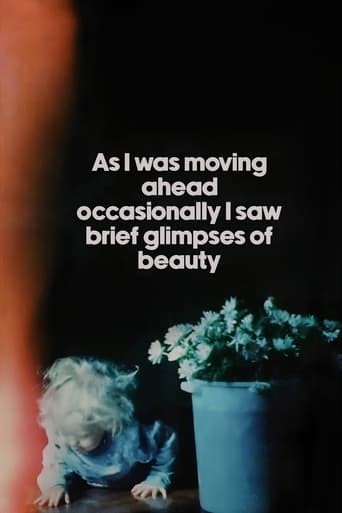
"Blue… symbolized the beginning of her spring."
Rubén tries to describe the color blue as "The color of dreams, of art, of the ocean and of the firmament", thereby unleashing half a century of poetry.
Social & External
Narrator
This film is dedicated to Mas-Félipe Delavouët, the poet discovered by Lawrence Durrell, who wrote 14,000 verses in Provençal over a period of thirty years, and who died on November 18, 1990. "The sky, history and Mediterranean and Provençal myths are the inexhaustable wellspring of this man rooted down there, near Salon-de-Provence" (J.-D. Pollet). "Mas-Félipe Delavouët wrote five books in Provençal, 14,000 verses. A sort of "Odyssey". Of myths. What is stunning in him is that he always talks of disappearances. Cities, works, men, writings, television, etc., everything has to disappear. In order to be reborn. No pain. A sort of hand-to-hand of man and nature. During the filming, I would simply throw out some words... For example, one time I said "creation" and he said: "creation doesn't exist..., creation is before me..., I can only read creation"; this sentence describes Delavouët perfectly (J.-D. Pollet, 1989 and 1993).
About Swedish artist, painter, sculptor and set designer Sven "X-et" Erixson, presented with Lars Johan Werle's music and accompanied by readings from various literature and poetry.
Réne Manzor's debut short, a surreal story about a tramp trying to build a road through the desert.
A portrait of Eric Lyons and Span, under the scrutiny of Ian Nairn, as well as the residents of their estates.
Lebanon today. The traces of the civil war are all too tangible as government corruption becomes unbearable. In a country where conflict and peace are caught in an endless cycle, musicians from different backgrounds pool their talents to create an underground music scene. Each evokes his or her representation of Lebanon: its shifting geographical, political, historical and social borders, its painful passage through conflict and instability. A touching portrait of a young generation trying to build an oasis in a hostile environment where the forces of destruction continue to wreak havoc.
TV documentary film about the life of New Zealand poet James K. Baxter.
Sir John Betjeman visits and explains the architecture of various churches in the Diocese of Norwich. Among those visited: Sandringham church on the Queen's private estate, the Holy House of Our Lady of Walsingham and Norwich Cathedral.
A lost chapter in black British film: extraordinary rushes from a documentary showcasing talented members of the black community.
Few will ever forget the 2003/04 season, as Chelsea recorded our second best ever seasonal campaign, propelling ourselves back into the big three of the English League with our second highest finish, and progressing further than ever before in the UEFA Champions League. There may be no trophies to show after a thrilling year, but strong foundations have been laid and there have been fond memories created along the way. It was a season to remembers as Claudio Ranieri prepared his group of international superstars for an attack on all fronts. On home soil, the team recorded the most points we have ever attained in the top-flight, with some fine victories along the way, most notably against arch-rivals Manchester United and Tottenham Hotspur, whilst in Europe, the 4-0 defeat of Lazio in their own back yard, became the biggest win by any foreign club on Italian turf at that time.
First film of Juan José Ponce’s trilogy about Federico García Lorca. Lunas de Nueva York looks back on Federico’s trip to New York in 1929, an essential journey for his life and career.
A symmetrically divided building: on one side, an important public hospital, on the other, a bewildering ruin. On the horizon, Rio de Janeiro, public health, education and Brazil’s aged modern project. Shot entirely in the monumental and only partially occupied modernist edifice of the University Hospital of UFRJ. A material metaphor of the Brazilian public sphere and its political maze. A synthesis architecturally expressed of the modernist utopia/dystopia.
In 2002, Ju Anqi made a film about a tour by the poet Shu through Xinjiang, the most western-lying, autonomous Uyghur province of China. All that we know about Shu is that he plays a poet who sends himself on a business trip - an absurd, satirical starting point that sets the tone for the film. For a variety of reasons, it was not until 2013 that Ju started editing the rough, lyrical material that he had shot in what is now a very restless Xinjiang: it's like an excellent wine that has had time to mature. Structured around 16 poems which he wrote on the road, Shu’s physically exhausting journey takes him along endless rocky roads, passing shabby inns and through impressive landscapes from one prostitute to the next. In its documentary authenticity, Poet on a Business Trip is also an historic document that exudes an atmosphere of loss, providing an unsentimental yet melancholy glimpse of a country in transition and a mirror for the existential irreversibility of time. (c) iffr.com
Bernadette Corporation describes this work as "A fashion film about the poetry of Stéphane Mallarmé and the color white." Produced for the 2000 Walker Art Center exhibition Let's Entertain, this short film employs a range of strategies to approach the idea of nothingness, emptiness, and vacuity, with an eye to how these notions relate to contemporary mass-cultural entertainment. Juxtaposing "documentary" takes on a fashion shoot with footage of semiologist Sylvère Lotringer giving an impromptu lecture on Mallarmé on a frozen lake, Hell Frozen Over maintains an ambiguous stance from which to both critique and celebrate the power of surface.
Through a child's lens, The Honest Poet reveals a rarely seen side of Afghanistan, following 11-year-old Raheem on a journey through his country and into the homes and hearts of his people.
Two hands over a light.
A Thousand Years of Joy charts poet/activist Robert Bly's journey from Midwestern farm boy to global troubadour, bestselling author of Iron John and leader of the men's movement.
Why isn't it green, yellow or striped?
A short documentary about the rapidly disappearing era of heritage movie palaces and the film going experience once offered within those hallowed walls.
An account of the life and work of the Spanish poet Luis García Montero; a journey through his experiences, his mentors, his influences and his contact with other artists, both from the literary world and from other disciplines.
Reading out loud one poem of Andrés Eloy Blanco, titled “Pleito de amar y querer” (Battle between loving and caring).